
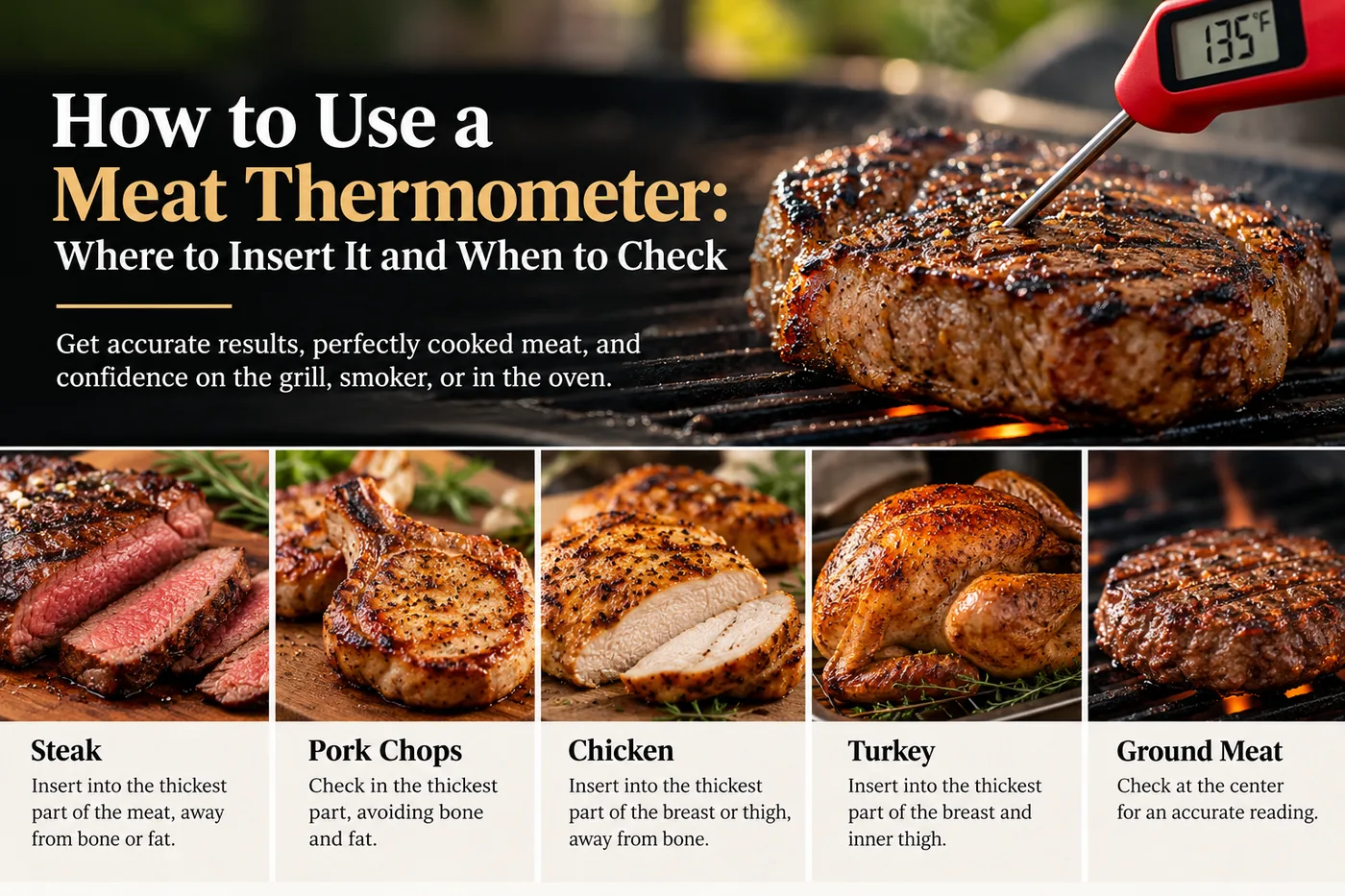
How to use a meat thermometer comes down to three things: put the sensing area in the coldest part of the food, avoid bone or large pockets of fat, and check in more than one spot when the piece is large or uneven. For instant-read thermometers, that usually means probing near the end of cooking and looking for the lowest stable temperature in the thickest part.
The Basic Method: Five Steps That Work for Most Meat
- Find the thickest part. That is usually the last area to finish cooking.
- Insert the probe so the sensing area reaches the center. On thin foods such as steak or pork chops, inserting from the side often makes this easier.
- Avoid bone, the pan and large fat pockets. Those can give a misleading reading.
- Move the probe slightly and watch the temperature. With a fast thermometer, the coolest stable reading near the center is the one that matters most.
- Verify the food has reached the applicable safe minimum temperature. Large cuts and whole birds should be checked in more than one place.
Instant-Read vs. Leave-In: Which One Should You Use?
An instant-read thermometer is best for spot checks: steaks, burgers, chicken pieces and final verification on larger cuts. A leave-in thermometer is best when you want continuous monitoring during a long cook without opening the grill or smoker repeatedly.
For frequent grilling and smoking, having both is useful. If you are deciding which style or model makes the most sense, see our Best Meat Thermometers for Grilling and Smoking guide for our comparison of instant-read and wireless options.
Where to Insert a Meat Thermometer in Steak
For steaks, the easiest method is usually to lift the steak with tongs and insert the thermometer from the side into the thickest part. Aim for the center of the meat, not the surface. If there is a bone, stay away from it.
This side-entry method also works well for burgers and other relatively thin foods because it gives you enough depth to place the sensing area in the middle instead of accidentally measuring close to the hot surface.
If you are comparing meat thermometers for steak, response time matters because you may be checking several pieces in quick succession.
How to Use a Meat Thermometer for Pork Chops
For a meat thermometer for pork chops, insert the probe into the thickest portion, ideally from the side if the chop is not very thick. Avoid touching the bone. Whole pork chops, roasts and steaks should reach 145°F (63°C) and rest for at least 3 minutes according to current federal food-safety guidance.
Ground pork is different: ground meat and sausage should reach 160°F (71°C).
Where to Put the Thermometer in Chicken
For a boneless chicken breast, insert the probe into the thickest part and keep the tip away from the cooking surface. Bone-in pieces should be checked in the thickest meat without touching bone.
Chicken and other poultry should reach 165°F (74°C). With several pieces on the grill, check more than one because thickness and grill hot spots can make them finish at different times.
Where Do You Insert a Meat Thermometer on a Turkey?
This is one of the most common thermometer questions. For a whole turkey, federal food-safety guidance says to verify 165°F (74°C) in the innermost part of the thigh, innermost part of the wing and thickest part of the breast.
If you are using a leave-in probe during the cook, place it deep in the breast meat without touching bone. Before serving, use an instant-read thermometer to verify the other recommended locations. In other words, whether you search for where do you place a meat thermometer in turkey or where do you stick a meat thermometer in a turkey, the important point is the same: do not trust one random spot on a whole bird.
Ground Meat, Burgers and Sausage
Ground meats need a different safety target from whole cuts. Ground beef, pork, lamb and veal should reach 160°F (71°C). Ground poultry should reach 165°F (74°C).
For a burger, insert the thermometer from the side into the center of the patty. This is usually more reliable than pushing straight down through the top, especially on thinner patties.
When Should You Check the Temperature?
With an instant-read thermometer, start checking near the end of the expected cooking time rather than waiting until the food looks done. Check early enough that you still have time to continue cooking if needed.
For long cooks such as brisket, pork shoulder or turkey, a leave-in probe can track progress continuously. Even then, I would verify final doneness with a fast instant-read thermometer in a few locations before serving.
Safe Minimum Internal Temperatures
| Food | Minimum internal temperature | Notes |
|---|---|---|
| Beef, pork, lamb and veal steaks/chops/roasts | 145°F / 63°C | Rest at least 3 minutes. |
| Ground beef, pork, lamb and veal | 160°F / 71°C | Includes sausage made from these meats. |
| Chicken, turkey and other poultry | 165°F / 74°C | Whole, pieces and ground poultry. |
| Fish | 145°F / 63°C | Or until flesh is opaque and separates easily with a fork. |
| Leftovers and casseroles | 165°F / 74°C | Verify in the center. |
Common Meat Thermometer Mistakes
- Touching bone: bone can give a temperature that does not represent the surrounding meat.
- Reading too close to the surface: the exterior heats faster than the center.
- Checking only one location: large roasts and whole birds can vary significantly from one spot to another.
- Waiting too long to check: by the time the outside looks overdone, the thermometer cannot undo it.
- Not cleaning the probe: wash or sanitize the probe between raw and cooked foods according to the thermometer maker's instructions.
Using a Thermometer With a Pellet Smoker or Griddle
Built-in grill probes are convenient, but a separate food thermometer is still useful for verification. On a pellet smoker, use a leave-in probe to follow a long cook and an instant-read thermometer to check several spots at the end. See our Best Pellet Smokers: What to Look For Before You Buy guide for the cooker side of the setup.
On a flat-top griddle, an instant-read thermometer is usually more useful because the cooking is fast and you are checking individual pieces. Our Blackstone griddle article is a good example of that kind of hot-and-fast cooking.
Bottom Line
Use the thermometer to find the coldest part of the food, not just the easiest place to reach. Aim for the thickest center, avoid bone, check more than one spot when the food is large, and verify the current safe minimum temperature before serving.
Research Sources & Methodology
This guide uses current U.S. federal food-safety guidance for minimum internal temperatures and thermometer-placement guidance from FoodSafety.gov, USDA FSIS and ThermoWorks educational resources. Manufacturer instructions should be followed for the sensing area, cleaning and use of your specific thermometer.