
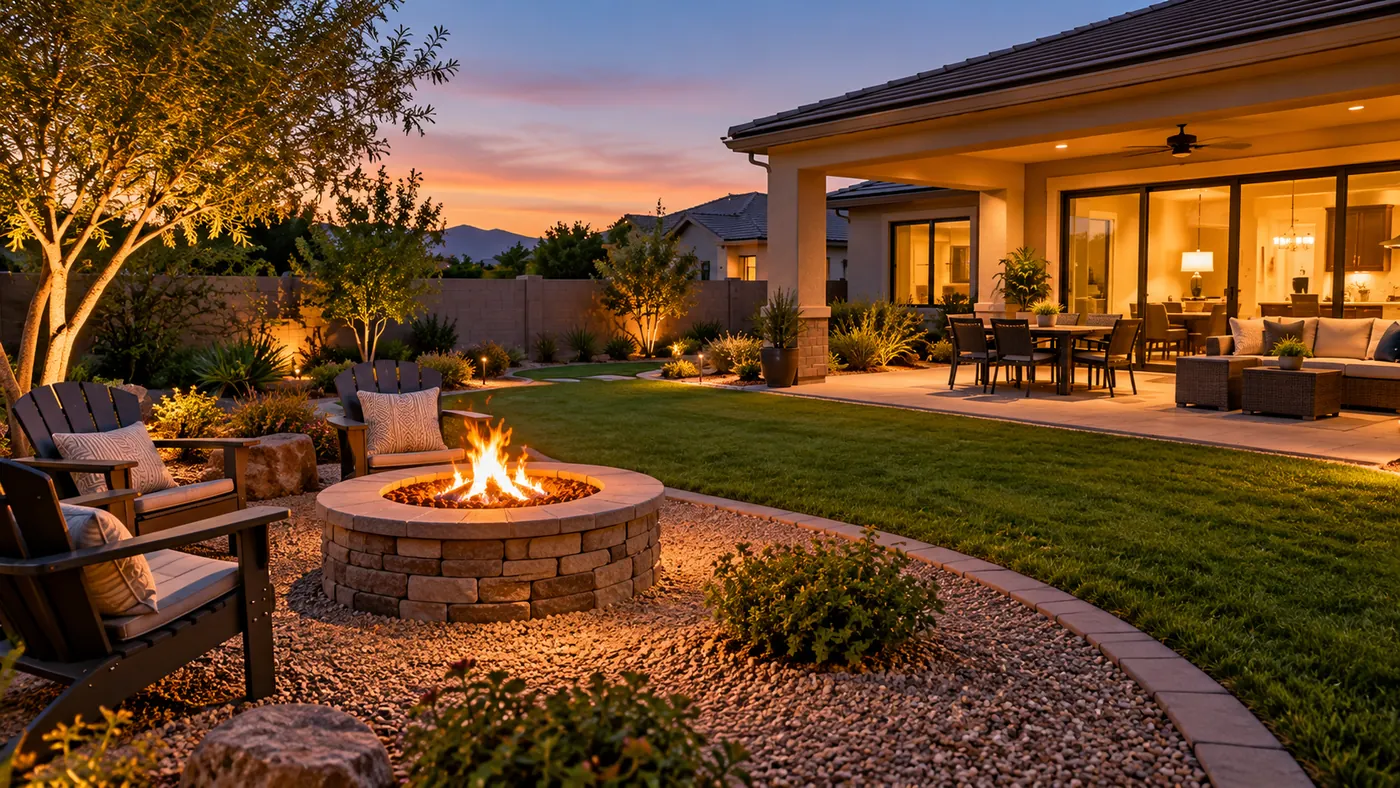
If you are trying to decide where a fire pit near the house should go, the easy answer is “not too close.” The more useful answer is that 10 feet is a sensible general baseline for many portable outdoor fire features, but you should never treat that number as permission to ignore the fire pit’s manual or your local requirements. A wood-burning pit that throws sparks is a different animal from a listed propane fire table with specific tested clearances.
How Close Can a Fire Pit Be to a House?
If you are searching for a fire pit near the house, do not choose the location based on appearance alone. A practical starting point is at least 10 feet from the home and other combustible materials, but the exact safe distance can be greater depending on the fire feature, wind, overhead structures and the manufacturer's instructions.
Wood-burning pits deserve more separation because sparks and embers can travel. Gas fire pits and fire tables do not throw wood embers, but they still have specific side and overhead clearances that should be followed exactly.
Why 10 Feet Is a Good Starting Point
The National Fire Protection Association’s public fire-safety guidance recommends using personal fireplaces and similar outdoor flame devices at least 10 feet from the home or anything that can burn. That makes 10 feet a practical baseline when you are planning a backyard layout.
But “10 feet” is not a one-size-fits-all code rule for every fire pit. Local jurisdictions can impose different restrictions, and listed gas appliances can have product-specific clearances. Think of 10 feet as the place to start the conversation—not the final answer for every installation.
Wood-Burning Fire Pits Need Extra Respect
With a wood fire, distance is only part of the problem. Sparks and embers can leave the pit, especially in dry or breezy conditions. Nearby roof overhangs, patio cushions, wood fencing, dry landscaping, trees and storage sheds all matter.
- Give the pit open space on all sides.
- Avoid placing it under tree branches or a low roof.
- Do not burn when wildfire danger or local restrictions are elevated.
- Keep a hose or fire extinguisher close enough to use immediately.
- Never use gasoline or similar liquid fuel to start or restart the fire.
For a permanent wood-burning pit, I would rather have more room than barely meet a minimum distance. The extra few feet rarely hurts the patio layout, and it gives you more margin when the wind changes.
Gas Fire Pits and Fire Tables Can Have Different Clearances
Propane and natural-gas fire features do not throw wood embers, but they still produce a lot of heat. Their safe placement should be based on the manufacturer’s installation instructions.
For example, Elementi states that its fire pits need 72 inches of overhead clearance above the tabletop. That is a good reminder that the space above a fire feature can matter just as much as the distance to the nearest wall.
If you have a fire table, do not assume that “it is gas, so it can go anywhere.” Check the manual for side clearances, overhead clearance, ventilation requirements and any restrictions on covered patios.
What About a Covered Patio?
This is where homeowners can get into trouble. A fire pit may be several feet from the house wall but still sit directly under a combustible ceiling, pergola, awning or patio umbrella.
| Check | Why it matters |
|---|---|
| Overhead clearance | Heat rises directly toward ceilings, umbrellas and pergola materials. |
| Ventilation | Gas-burning products need the outdoor airflow specified by the manufacturer. |
| Roof and beam material | Wood and other combustible finishes can be affected by radiant and rising heat. |
| Manufacturer approval | Some units are suitable for certain covered outdoor locations; others are not. |
If the manual does not clearly say the unit can be used in your covered location, do not guess. Contact the manufacturer or your local fire/building authority.
Wind Can Change a Good Location Into a Bad One
A fire pit can look perfectly placed on a calm afternoon and become much less comfortable—or less safe—when the evening breeze starts pushing heat, smoke or sparks toward the house.
Before building a permanent pit, pay attention to the normal wind direction in your yard. If smoke routinely blows toward a door, window or covered patio, moving the pit several feet can make a much bigger difference than changing the style of fire pit.
Do Not Forget Fences, Furniture and Landscaping
The house is not the only combustible object in the yard. When you measure your fire-pit location, look in every direction.
- Wood and vinyl fencing
- Outdoor sofas and cushions
- Umbrellas and shade sails
- Dry shrubs, grasses and tree branches
- Storage boxes and sheds
- Wood decking
- Propane cylinders and other fuel containers
A fire pit can be 10 feet from the house and still be poorly placed if it is two feet from a dry hedge.
A Practical Backyard Placement Check
Before you decide “this is the spot,” run through this quick check:
| Question | What I would do |
|---|---|
| Is it at least 10 ft from the home or obvious combustibles? | Use that as the general starting point. |
| Does the product manual require more? | Follow the manual. |
| Is there a roof, umbrella or tree overhead? | Verify the required overhead clearance. |
| Is the surface stable and suitable? | Use a level, manufacturer-approved surface. |
| Does wind carry smoke or flame toward the house? | Move the pit or choose another location. |
| Are wildfire restrictions in effect? | Do not burn. |
| Can you reach a hose or extinguisher quickly? | Have one ready before lighting. |
How This Changes by Fire Feature
If you are still choosing the type of outdoor fire feature, the placement question is only one part of the decision. A traditional fire pit, fire table and fire bowl each change the way people sit around the flame, how much heat you feel and how the unit fits into the patio.
See our Firepit, Fire Table or Fire Bowl? guide for a side-by-side comparison of the three formats.
Bottom Line
Use 10 feet as a general starting point, not as a blanket guarantee. The safest placement is the one that satisfies the manufacturer’s instructions, local rules and the actual conditions in your yard—including wind, overhead structures and nearby combustibles.
My simple rule
If you have room to move a wood-burning pit farther away without ruining the layout, do it. For a gas fire table or bowl, follow the tested clearances in the manual rather than relying on a generic number from the internet.
Related: If you are considering a fire table under a patio roof, see Can You Put a Fire Table on a Covered Patio?
Research Sources & Methodology
This article uses public fire-safety guidance and manufacturer information as a general planning reference. Fire codes and product requirements vary by location and model, so always check your specific manual and local authority before installing or using a fire feature.