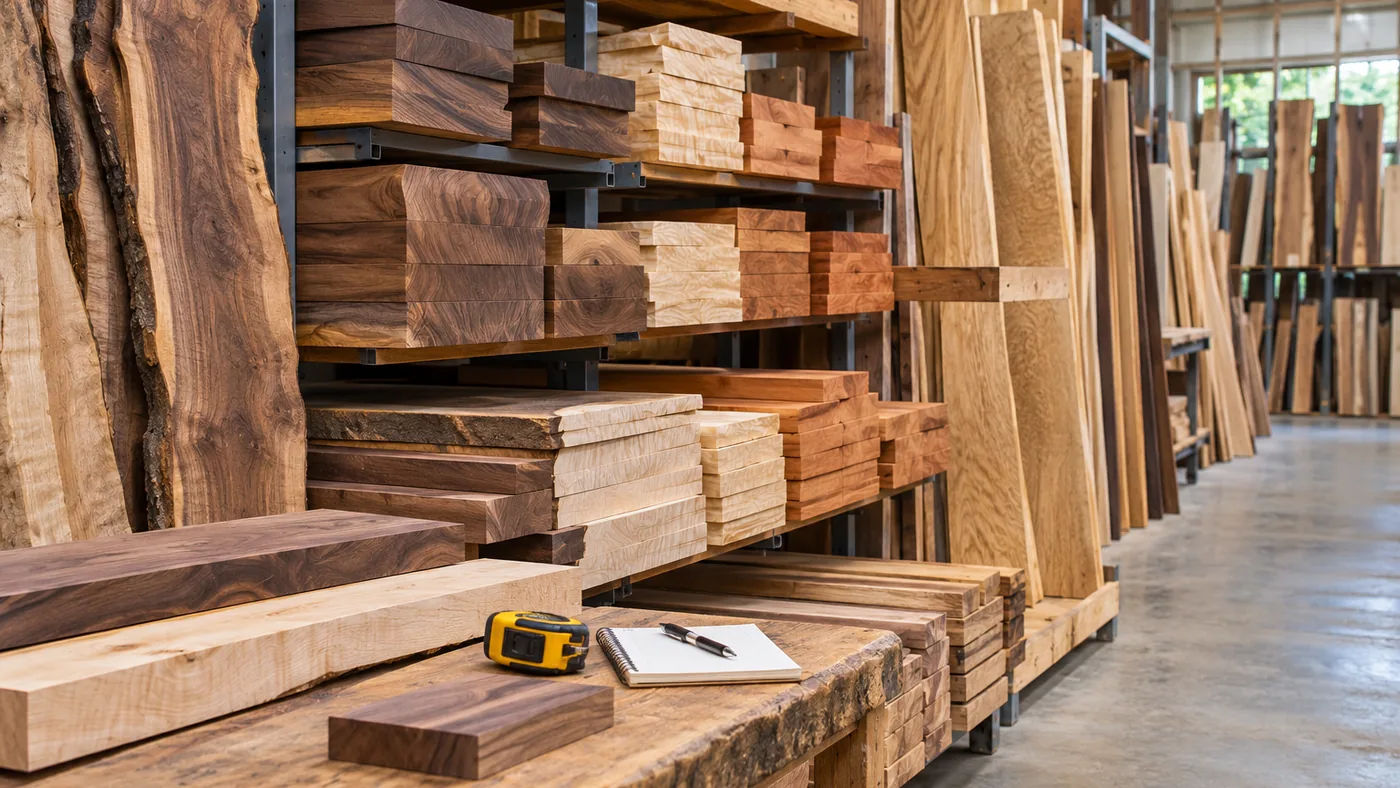
Buying hardwood lumber is not difficult once you know what the lumber yard is actually telling you. The confusing part is that hardwood dealers use a different language from the one most homeowners learn in the construction-lumber aisle. Instead of grabbing a labeled 1×6 that is already planed on four sides, you may be choosing from rough boards of different widths, thicknesses and grades, then paying by volume rather than by the piece.
You do not need to become a lumber grader before your first visit. You only need enough vocabulary to understand what you are looking at, what you are paying for and how much work the board will need before it is ready for a project.
This guide explains the hardwood-lumber terms beginners run into most often: what 4/4 lumber means, what rough-sawn lumber is, how to calculate board feet, how surfaced lumber differs from rough stock, and when plain-sawn, quarter-sawn or rift-sawn grain matters.
Why a Hardwood Lumber Store Feels Different From a Big-Box Store
At a big-box store, most boards are sold as individual pieces with familiar nominal sizes. The board is usually surfaced, relatively uniform and easy to compare against the one beside it.
A hardwood dealer may instead have long racks of walnut, maple, cherry, oak and other species in random widths and lengths. Some boards may be rough on both faces. Some may have one straight edge. Thickness may be labeled 4/4, 5/4 or 8/4. The price may be shown per board foot rather than per board.
That sounds more complicated, but it gives you far more control. You can choose boards for color, grain, width and figure instead of simply buying whatever dimensions happen to be stocked.
What Does 4/4 Lumber Mean? 4/4, 5/4, 6/4 and 8/4 Explained
Hardwood thickness is commonly expressed in quarters of an inch. The fraction is a naming system for the rough thickness, not a promise that the finished board will measure exactly that size after surfacing.
| Lumber label | Say it as | Approximate rough thickness | Typical reason to buy it |
|---|---|---|---|
| 4/4 | “four-quarter” | About 1 inch | Furniture parts, shelves, cabinet parts and general woodworking |
| 5/4 | “five-quarter” | About 1¼ inches | Projects needing a little more finished thickness |
| 6/4 | “six-quarter” | About 1½ inches | Thicker legs, rails, tops and furniture components |
| 8/4 | “eight-quarter” | About 2 inches | Table legs, thick tops, turning blanks and substantial furniture parts |
The important beginner point: if you need a finished 1-inch-thick part, do not assume 4/4 rough lumber will get you there. Flattening and planing remove material. Ask the dealer what finished thickness you can reasonably expect from the stock they are selling.
What Is Rough-Sawn Lumber? Rough, S2S, S3S and S4S Explained
Rough sawn lumber (also written rough-sawn lumber) has not yet been finish-planed smooth and square on all sides. At a hardwood dealer, you may see rough lumber beside boards labeled S2S, S3S or S4S. Those abbreviations describe how many surfaces have already been milled smooth or straight.
| Term | Plain-English meaning | What it means for you |
|---|---|---|
| Rough | Faces and edges have not been finish-planed | Maximum control and often better yield, but you need milling equipment or dealer services |
| S2S | Surfaced two sides | The two broad faces are generally planed; edges may still be rough |
| S3S | Surfaced three sides | Two faces plus one straight edge are prepared |
| S4S | Surfaced four sides | Both faces and both edges are milled, closest to the boards most big-box shoppers are used to |
If you do not own a jointer and planer, S3S or S4S can make your first hardwood purchase much easier. Many hardwood dealers will also surface or straight-line-rip boards for an additional charge.
What Is a Board Foot? How to Calculate Board Feet
A board foot is a volume measurement commonly used to price hardwood lumber. One board foot equals a piece of wood 1 inch thick, 12 inches wide and 12 inches long.
For example, if you are learning how to calculate board feet in lumber, start with a board that is 1 inch thick, 8 inches wide and 8 feet long. Convert the 8-foot length to 96 inches. The calculation is:
1 × 8 × 96 ÷ 144 = 5.33 board feet.
If walnut is priced at $12 per board foot, that board would cost roughly $64 before any milling charges or other fees. Dealers may have their own measuring and rounding practices, so use your calculation as a planning estimate rather than an argument at the counter.
Plain-Sawn vs. Quarter-Sawn vs. Rift-Sawn Lumber
These terms describe how a board was cut from the log. The cut changes the way the grain appears and can also affect dimensional stability.
| Cut | What the grain usually looks like | Why you might choose it |
|---|---|---|
| Plain-sawn / flat-sawn | More sweeping, cathedral-like grain on many species | Common, widely available and usually the most economical |
| Quarter-sawn | Straighter grain with distinctive ray fleck in species such as white oak | Chosen for appearance and improved stability across the board’s width |
| Rift-sawn | Very straight, even grain with less ray fleck | Excellent when you want consistent straight grain, especially on furniture legs and visible parts |
You do not need quarter-sawn or rift-sawn lumber for every project. For many beginner builds, ordinary plain-sawn hardwood is completely appropriate. The special cuts matter when the grain appearance or stability is important enough to justify the extra cost.
Sapwood vs. Heartwood
Heartwood is the older wood toward the center of the tree. Sapwood is the younger, active wood closer to the bark. They can look dramatically different depending on the species.
Walnut is a good example: the heartwood is typically the darker brown color people associate with walnut, while the sapwood can be much lighter. Cherry, maple and other species also show color differences between heartwood and sapwood.
Neither one is automatically “bad.” The question is whether the color variation works for your project. If you want a consistent dark walnut tabletop, inspect each board for how much light sapwood is present. If you like contrast, that same sapwood may become part of the design.
Hardwood Lumber Grades: What Does FAS Mean?
Hardwood grading is mostly about the amount of clear, usable wood that can be cut from a board—not whether a board is pretty enough for your project.
FAS is a high hardwood grade intended to provide a high percentage of large clear cuttings. You may also see terms such as Select, #1 Common and #2 Common. Lower grades can contain more knots and defects, but they can also be excellent values for smaller parts because you may be able to cut around those defects.
For a beginner, the practical question is usually simpler than the grading rules: Can you get the clear pieces you need from this board without buying a lot of unusable wood?
How to Inspect a Hardwood Board Before You Buy It
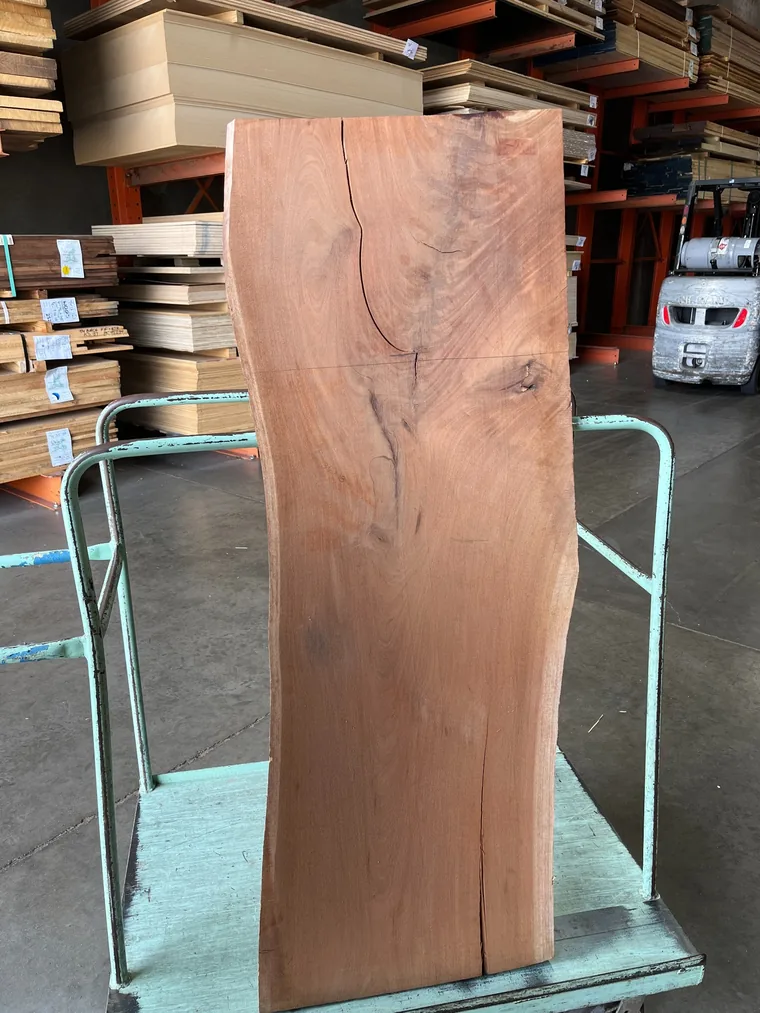
Do not look only at the grain on the face. Sight down the length of the board and check its overall shape.
| What to look for | What it means |
|---|---|
| Bow | The board curves along its length when viewed from the side |
| Crook | An edge curves sideways along the length |
| Cup | The board curves across its width like a shallow trough |
| Twist | The corners do not lie in the same plane; usually one of the more wasteful defects to flatten |
| Checks or splits | Cracks, often near the ends, that reduce usable length |
| Knots | May be decorative or may weaken/interfere with the parts you need |
| Wane | Bark or missing wood along an edge |
A slightly bowed or cupped board may be perfectly usable if you have enough thickness and width to mill it flat. A badly twisted board can consume a surprising amount of material before it becomes straight.
Can You Sort Through the Stack?
Usually, yes—but treat the lumber and the store with respect. Hardwood boards can be heavy and expensive. Do not drag boards across one another, leave a pile on the floor, or make the staff restack everything you moved.
Ask if you are unsure about the store’s policy. If sorting is allowed, pull one board at a time, inspect both faces and edges, and return unwanted boards neatly to the same stack.
How Much Lumber Should You Buy?
Do not buy exactly the finished board-foot total shown on your project plan. Some wood will disappear when you square ends, flatten faces, remove defects, match grain and make mistakes.
For straightforward furniture projects, a beginner may want to add roughly 15–25% extra as a planning cushion. Projects with highly selective grain matching, many defects or unusually shaped parts may need more.
If you are buying wide boards specifically because of their appearance, buy based on the actual boards in front of you rather than trying to hit a mathematical total perfectly.
Kiln-Dried, Air-Dried and Moisture Content
Most indoor furniture projects are easier with properly dried lumber. Kiln-dried wood has been dried in a controlled kiln; air-dried wood has dried more gradually under covered, ventilated conditions.
The label alone does not tell you whether the wood is ready for your shop. Ask about moisture content if it matters for the project, and allow newly purchased lumber time to acclimate to your shop before final milling and assembly.
What to Ask the Lumber Yard
- Is this lumber rough, S2S, S3S or S4S?
- What finished thickness should I expect after surfacing?
- Is the price per board foot or per piece?
- Do you have a minimum board-foot purchase?
- Can you straight-line one edge or surface the board for me?
- Can boards be cut shorter for transport, and is there a cutting fee?
- Is the lumber kiln-dried, and do you know its approximate moisture content?
- Can customers sort through the stack?
Buying Hardwood Online vs. at a Local Lumber Yard
Online hardwood sellers can be useful when you do not have a good dealer nearby or need a particular species, figured board or small quantity. The tradeoff is that shipping can be expensive and you may not get to choose the exact board unless the seller offers photographed individual pieces.
A local lumber yard gives you the advantage of inspecting color, grain, width and defects yourself. For a first hardwood purchase, that hands-on experience is especially valuable because you quickly learn what the terminology looks like in real wood.
Your First Trip: The Five Things You Actually Need to Know
- Know the species. “I need walnut” is more useful than “I need a dark board.”
- Know the finished thickness you need. The yard can help you choose the right rough thickness.
- Know whether you can mill rough lumber. If not, ask for surfaced stock or milling services.
- Know approximately how many board feet you need. Add a reasonable waste allowance.
- Take your time choosing boards. Grain, color and straightness matter more than memorizing every lumber term.
You do not need to walk in sounding like a professional cabinetmaker. Tell the staff what you are building and what equipment you have. A good hardwood dealer is used to helping customers translate a project into the right stock.
Related Workshop Guides
- Board Foot Calculator — calculate board feet and estimated hardwood cost instantly.
- Wood Routers Buying Guide — choosing the right router once your stock is ready to shape.
- Best Table Saw Blade for Plywood — understanding blade choice and cut quality.
- How to Cut Plywood Like a Pro — a useful comparison point for working with sheet goods instead of solid hardwood.
- DIY Workbench Build — a practical workshop project for supporting future hardwood builds.
Research Sources & Methodology
This beginner guide uses standard hardwood-lumber terminology and measurement conventions. Dealer practices can vary, especially for surfacing, measuring, rounding and minimum purchases, so confirm the details with the lumber yard where you shop.
Bottom Line
The unfamiliar part of buying hardwood is mostly vocabulary. Once you understand quarter thicknesses, board feet, surfacing and basic grain cuts, a hardwood lumber yard becomes much less intimidating. Start with the finished dimensions your project needs, inspect each board carefully, and ask the yard to explain anything that is not clear.
Before You Leave the Yard
- Confirm the species.
- Confirm thickness and surfacing.
- Check both faces and edges.
- Calculate the approximate board feet.
- Leave room for waste and milling.
- Ask before cutting long boards for transport.