
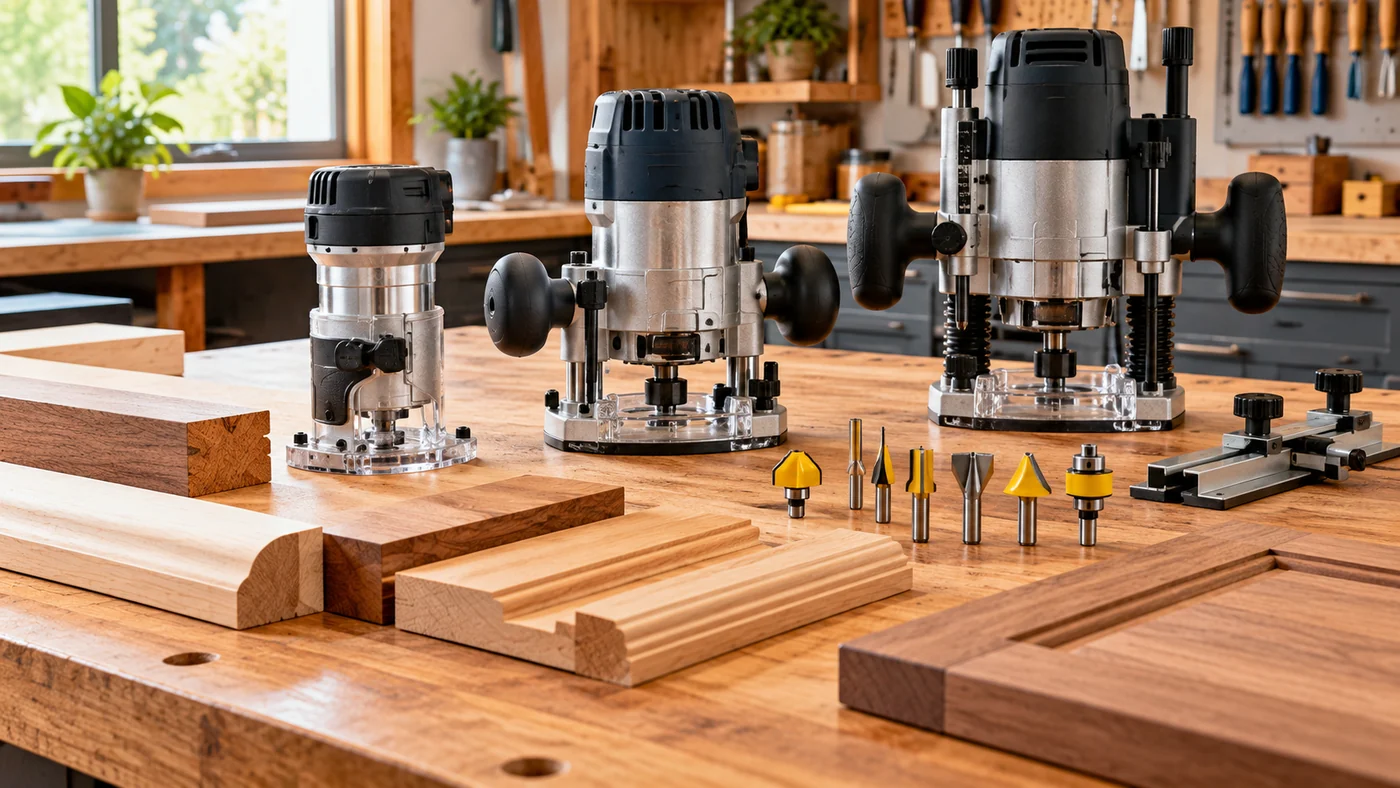
Wood routers are one of those tools that seem specialized until you own one. Then little jobs start appearing everywhere. A sharp edge needs a roundover. A shelf wants a dado. A cabinet hinge needs a clean recess. A template would save an hour of careful measuring. Suddenly the router is not a specialty tool anymore; it is the machine you keep reaching for because it can do the awkward little precision jobs that saws do not handle gracefully.
The confusing part is choosing the first one. Compact router? Fixed base? Plunge base? Cordless? Two horsepower? Three? Quarter-inch bits? Half-inch bits? Router table? The boxes make it sound as though every router is meant for every job. They are not.
The easiest way through the noise is to think about how the tool feels in the cut. Small routers are light and nimble. Mid-size routers feel planted and versatile. Plunge routers are built for controlled vertical movement. Big routers have the torque for large cutters and table work, but you notice every extra pound when you are balancing one on the edge of a cabinet door.
What a Wood Router Actually Does
A router spins a cutting bit at very high speed and lets you guide that cutter along an edge, through a template or into the face of a workpiece. Change the bit and the personality of the tool changes with it.
| Job | Typical bit or setup | Router style that feels natural |
|---|---|---|
| Round over or chamfer an edge | Bearing-guided edge bit | Compact or mid-size fixed-base router |
| Cut a dado or groove | Straight or spiral bit with edge guide | Fixed-base or plunge router |
| Cut a mortise | Upcut spiral or straight bit | Plunge router |
| Flush-trim a template | Flush-trim / pattern bit | Compact or mid-size router |
| Raise panels or run large profiles | Large-diameter 1/2-in.-shank bits | Powerful variable-speed router, usually in a router table |
| Trim laminate or veneer | Small flush-trim bit | Compact / trim router |
Compact Routers: The Tool You Reach For
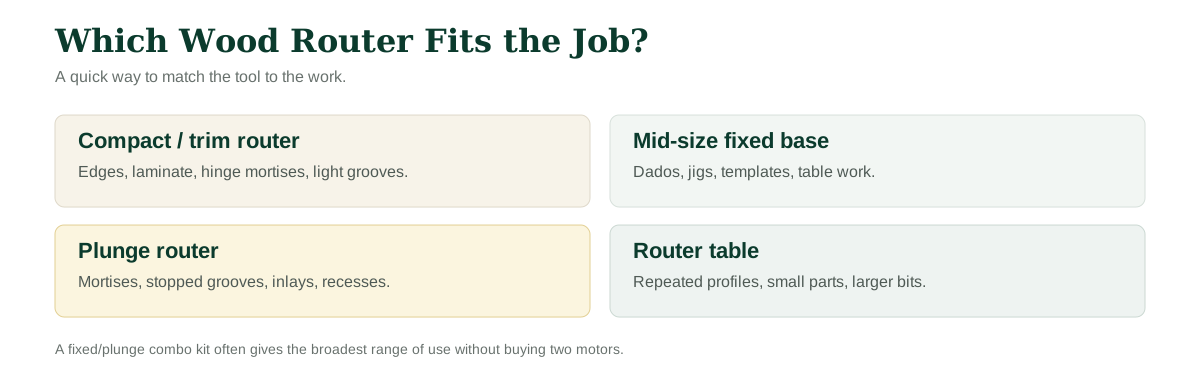
Compact routers—often called trim or palm routers—have become wildly useful because they are light enough to use one-handed for many jobs. Edge profiles, hinge mortises, small dados, pattern work and quick cleanup cuts all suit them.
The Makita RT0701CX7 is a good example of the category, typically around $229 for the plunge-base kit. It is a 1-1/4 HP compact router kit with fine depth adjustment and a plunge base. The Milwaukee M18 FUEL Compact Router, typically around $229 tool-only, represents the cordless side, with variable speed from 10,000 to 31,000 RPM and optional plunge and offset bases.
The limitation is not quality. It is size. A compact router is happiest with smaller 1/4-inch-shank bits and moderate cuts. Ask it to swing a large raised-panel cutter and you are using the wrong machine.
Mid-Size Routers: The All-Rounders
If someone told me they wanted one router to cover as much workshop territory as possible, this is the class I would look at first. Mid-size routers have enough power for serious edge work, dados, templates and router-table duty without becoming exhausting to use freehand.
The long-running Bosch 1617EVSPK, typically about $260–$280, is a useful example because the kit includes both fixed and plunge bases, variable speed from 8,000 to 25,000 RPM, and both 1/4-inch and 1/2-inch collet capacity.
That combination—one motor, two bases—is hard to ignore. The fixed base handles routine edge work and table use. The plunge base takes over when a cut needs to start inside the workpiece.
Plunge Routers: Different Movement, Different Jobs
A plunge router lets the motor and bit move vertically while the base stays planted on the work. That sounds like a small distinction until you try cutting a stopped groove or mortise with a fixed base.
With a plunge base, you can position the router, start the motor, lower the bit smoothly into the work, make the cut and lift it back out. The motion feels controlled because the base never leaves the workpiece.
Plunge bases are especially useful for mortises, stopped dados, inlays, template recesses and any cut that begins away from an edge. They are also excellent with jigs because the cutter can enter and exit the work without tipping the router.
Fixed Base vs. Plunge Base
| Feature | Fixed base | Plunge base |
|---|---|---|
| Feel in the hand | Lower, simpler and often a little easier to control on edges. | Taller and spring-loaded, but very controlled for vertical entry cuts. |
| Depth setting | Set the bit height before the cut. | Set a plunge stop, then lower the spinning bit into the work. |
| Best-known jobs | Edge profiles, template routing, dados from an edge, router-table use. | Mortises, stopped grooves, inlays, recesses and interior cuts. |
| Learning curve | Very straightforward. | Takes a few cuts to get comfortable with the plunge action and depth stops. |
Combo kits exist because neither base completely replaces the other. If the price difference is reasonable, a motor with both bases gives you a lot of flexibility without duplicating the expensive part of the tool.
Corded or Cordless?
Cordless compact routers have become good enough that this is no longer a novelty question. For edge work, trim work, small grooves and jobsite use, not dragging a cord across the workpiece is genuinely pleasant.
There is also a little less mental housekeeping. You pick up the router, make the cut and put it down. No extension cord. No cord catching a corner midway through a pass.
Corded routers still make a lot of sense for long sessions, bigger cutters and router tables. A router mounted under a table does not benefit much from being cordless, and large motors running large bits are exactly where continuous power is useful.
| Situation | Cordless advantage | Corded advantage |
|---|---|---|
| Quick edge work | No cord to manage; very convenient. | Works indefinitely without battery planning. |
| Jobsite / installation work | Easy to carry and use away from outlets. | Less relevant unless power is already nearby. |
| Large bits | Some newer cordless routers are surprisingly strong. | Still a natural fit for sustained heavy cuts. |
| Router table | Battery access can be awkward. | Usually the simpler permanent setup. |
Horsepower Numbers Need Context
Router horsepower ratings are useful for sorting tools into broad classes, but they are not a reason to buy the largest motor you can afford.
A 1 to 1-1/4 HP compact router feels lively because the whole machine is small. A 2 to 2-1/4 HP router has noticeably more reserve for deep dados, heavier edge profiles and table work. Big 3-plus-HP routers are built for large bits, heavy stock removal and serious router-table duty.
More power also means more weight. That extra mass can be reassuring on a router table and tiring when you are freehand routing the edge of a six-foot workpiece.
1/4-Inch vs. 1/2-Inch Router Bits
This is one of the few specifications I would think about early.
Compact routers are generally built around 1/4-inch shanks. That covers a huge amount of real-world work. But larger routers often accept both 1/4-inch and 1/2-inch collets, and the bigger shank has advantages when the cutter itself gets large.
| 1/4-inch shank | 1/2-inch shank |
|---|---|
| Common in compact routers and smaller bits. | Common in mid-size and large routers. |
| Plenty for roundovers, chamfers, laminate work and many grooves. | More mass and stiffness for larger cutters and heavier cuts. |
| Usually less expensive bit-to-bit. | Often preferred for large profiles and router-table work. |
If you expect to grow into a router table, cabinet doors or larger molding profiles, having 1/2-inch collet capability gives you room to grow.
Variable Speed Is Not a Luxury
Small router bits are happy spinning fast. Large-diameter bits should run slower. That is the basic reason variable speed matters.
A compact straight bit may live near the high end of the dial. A big panel-raising or molding cutter can require dramatically lower speed. The bit manufacturer’s maximum RPM is the number that matters, not habit.
Variable speed also helps with materials that burn easily. Slowing the cutter slightly, sharpening the bit or increasing feed rate can clean up a scorched edge faster than sanding it afterward.
Soft Start
A router with soft start comes up to speed progressively instead of snapping to full RPM the moment you hit the switch.
It sounds like a comfort feature until you use a larger router. The tool feels calmer in your hands, especially with a heavier bit installed. That little reduction in drama makes setup and control easier.
Electronic Speed Control
Better routers try to maintain the selected speed as the cutter enters the wood. Bosch calls this Constant Response circuitry on the 1617EVSPK.
What you feel is less bogging when the cut gets heavier. You still need sensible depth and feed rate, but the motor does not seem as eager to change personality halfway through the board.
Depth Adjustment: This Is Where Good Routers Feel Good
A router can have plenty of power and still be annoying if the depth adjustment is vague.
Fine adjustment matters because routing often involves sneaking up on a fit. A dado may need another few thousandths. A flush trim cut may need the bearing moved just enough. A hinge mortise can go from perfect to sloppy very quickly.
Look for an adjustment system that moves smoothly, locks positively and can be repeated without wrestling the motor in the base. On plunge routers, turret stops and a readable depth rod make multi-pass cuts much easier.
The Router Table Question
A router table does not replace handheld routing. It changes which part moves.
Handheld, you move the router across the wood. In a router table, the router is fixed upside down and you move the wood past the bit. That is often better for narrow pieces, repeated profiles and operations where keeping the tool balanced on the work would be awkward.
If table use is in your future, look at how easily the router mounts, whether bit height can be adjusted from above the table and how easy it is to change bits. The Bosch 1617EVSPK fixed base, for example, is designed to allow bit-height adjustment from above compatible router tables.
Representative Current Routers
This is not a ranking. These models are useful because they show the main categories clearly. Prices below are approximate current street prices and can move with promotions.
| Model | Type | Estimated price | Why it is useful as a reference point |
|---|---|---|---|
| Makita RT0701CX7 | 1-1/4 HP compact kit | About $229 | Compact size, fine rack-and-pinion adjustment and included plunge base make it a good example of a versatile trim-router kit. |
| Milwaukee M18 FUEL 2723-20 | Cordless compact router | About $229 tool-only | Shows how far cordless trim routers have come: variable speed, micro depth adjustment, LEDs and optional plunge/offset bases. |
| Bosch 1617EVSPK | 2.25 HP fixed/plunge combo | About $260–$280 | A classic mid-size format with both bases, variable speed, 1/4- and 1/2-inch collets and router-table compatibility. |
Estimated prices checked in October 2026. Retail promotions and availability can change quickly.
Bits Matter as Much as the Router
A mediocre bit can make a good router look bad. Dull cutters burn, tear fibers and make the motor work harder. Well-made sharp bits cut more quietly and leave less sanding behind.
You do not need a 50-piece set on day one. A small group of useful bits goes surprisingly far:
- 1/4-inch and 1/2-inch roundover bits
- 45-degree chamfer bit
- flush-trim or pattern bit
- straight or spiral bits for grooves and dados
- rabbeting bit set
- small ogee or decorative profile if you build trim or furniture
Buy the oddball profile when a project actually calls for it. Router-bit drawers have a way of filling themselves over time.
Spiral Bits vs. Straight Bits
Straight bits are simple, affordable and still useful. Spiral bits cut with a shearing action that can feel smoother, especially in plywood, mortises and deeper grooves.
An upcut spiral clears chips aggressively upward. A downcut pushes fibers downward and can leave a cleaner top edge. Compression bits combine cutting directions and are popular for plywood because they can leave both faces cleaner when the cut depth is appropriate.
The tradeoff is cost. Good spiral bits are not cheap. For the jobs where they shine, though, the difference is easy to see.
Dust Collection
Routers produce chips in every direction. A dust shroud helps most when the cut is enclosed—dados, mortises, some plunge operations. Edge routing is harder because half the cutter is out in the open.
I would treat dust collection as a worthwhile feature, not a promise of a clean bench. You will still own a broom.
LED Lights
Lights sound trivial until you are following a pencil line inside a cabinet or watching the edge of a template.
They do not make the router more accurate, but they make it easier to see what you are trying to be accurate about. On compact routers especially, I like them.
How Much Router Do You Need?
| If this sounds like your workshop... | Start looking at... |
|---|---|
| Mostly edge profiles, trim work and occasional grooves | A compact router, corded or cordless. |
| General woodworking with dados, jigs, templates and edge work | A 2 to 2-1/4 HP variable-speed router, ideally with fixed and plunge bases. |
| Cabinet doors, large profiles and regular router-table use | A router with 1/2-inch collet capacity, strong variable-speed motor and good table adjustment. |
| On-site installation and finish work | A cordless compact router is especially convenient. |
| Mortises, stopped grooves and inlays | A plunge router or combo kit with a plunge base. |
Common Buying Mistakes
- Buying the biggest router first. Large routers have their place, but they are not as pleasant for light handheld work.
- Ignoring collet size. If you expect large bits later, 1/2-inch capability matters.
- Skipping variable speed. Large cutters often require lower RPM.
- Buying a router before thinking about the base. A plunge base can be more important than another half horsepower.
- Judging everything by horsepower. Adjustment quality, balance and base design affect every cut you make.
- Buying lots of cheap bits instead of a few good ones. You feel the bit in the finished surface.
Before You Buy
- List the first five jobs you realistically expect the router to do.
- Decide whether those jobs need plunge capability.
- Check whether 1/2-inch bits are in your future.
- Look for variable speed and soft start on mid-size and larger routers.
- Handle the router if you can. Grip and balance matter.
- If router-table use is likely, check mounting and above-table adjustment.
- Budget for bits, an edge guide, dust collection and possibly a template-guide set.
The Useful Way to Think About It
A compact router is a terrific specialist that often becomes an everyday tool. A mid-size combo kit is the broadest all-rounder. A larger router earns its keep when the bits get bigger or the tool moves under a table.
What You Will Notice After a Year
- Depth adjustment matters more than the horsepower sticker.
- Good bits are worth paying for.
- A plunge base opens up an entirely different group of cuts.
- Router tables make awkward work feel routine.
- You will eventually own more router bits than you planned.
Related Workshop Guides
Research Sources & Methodology
Specifications and representative features were checked against manufacturer product pages. The guide focuses on how router types and features affect ordinary workshop use rather than ranking individual models.