
A table saw and a track saw can both make beautifully straight cuts, but they solve the job from opposite directions. With a table saw, you bring the work to the blade. With a track saw, you bring the blade to the work. That difference sounds small until you are standing in a garage trying to wrestle a full sheet of plywood onto a saw by yourself.
The better question is not which saw is “better.” It is which one matches the material you cut most often, the space you have, and the way you like to work.
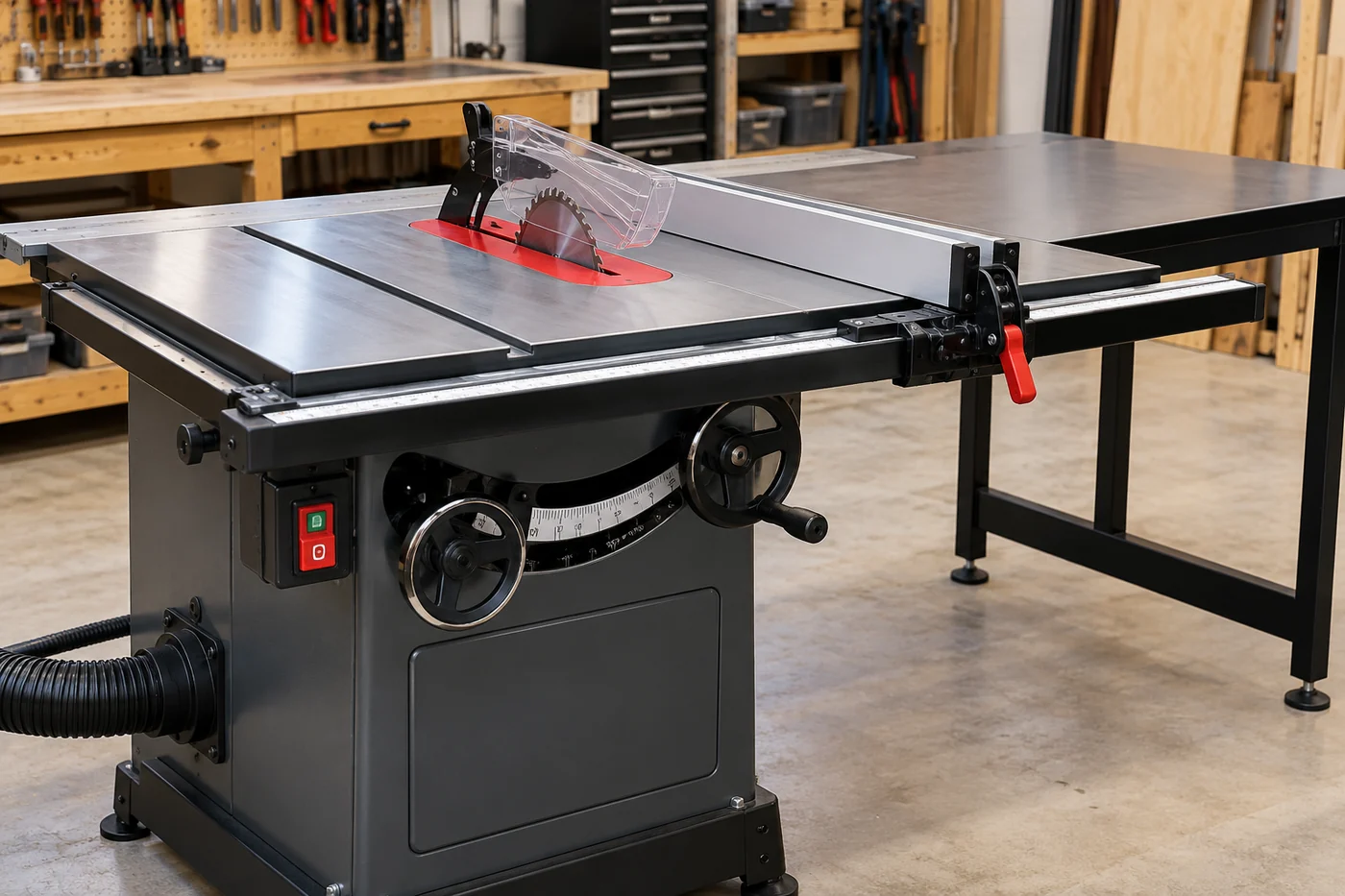
Table Saw
The table supports the work while the fence establishes the cut width. That setup makes repeatability feel almost effortless once the saw is dialed in.
It is especially natural for ripping lumber, cutting narrow pieces, making repeated parts and handling a wide range of jigs and joinery operations.
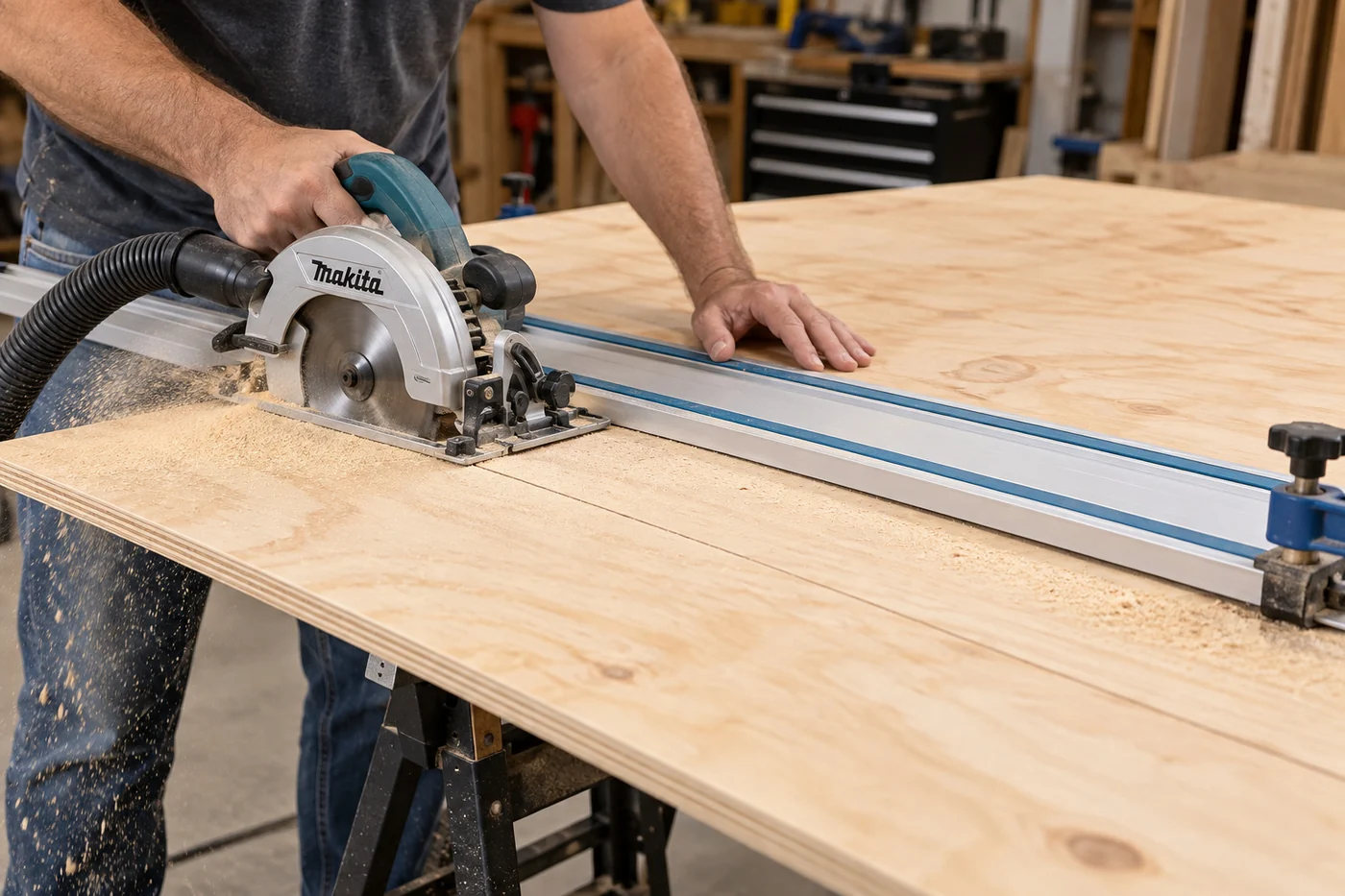
Track Saw
The guide rail goes on the workpiece and the saw rides along it. Large sheets stay put while the tool moves, which is a very different experience from feeding plywood across a stationary table.
That makes track saws particularly comfortable for sheet goods, doors, countertops, installation work and small shops.
Table Saw vs. Track Saw at a Glance
| Job or feature | Table saw | Track saw |
|---|---|---|
| Breaking down full plywood sheets | Capable, but the sheet has to be controlled around the saw. | One of its strongest jobs; the sheet can stay supported in place. |
| Ripping dimensional lumber | Excellent and very repeatable. | Good, but usually less convenient for routine ripping. |
| Repeated identical cuts | Excellent once the fence is set. | Accurate, but the track must be positioned for each cut unless you add accessories. |
| Narrow pieces | Well suited with proper technique, guards and push devices. | Usually not the natural choice. |
| Portability | Jobsite models travel, but they still need operating space. | Excellent; the saw and tracks store compactly. |
| Small-shop storage | Requires a footprint and infeed/outfeed room. | Very little permanent floor space. |
| Precision | Excellent when aligned and calibrated. | Excellent when the rail is positioned carefully. |
| Dust collection | Ranges from fair to excellent depending on saw design. | Often very good when paired with a dust extractor. |
| Jobsite / installed work | Possible, especially with portable models. | Excellent because the tool travels to the work. |
Where the Table Saw Feels Better
Repeated parts
Build a bookcase and cut twelve shelves to the same width. Set the fence once, verify it, and the rest becomes a rhythm. That is where a table saw earns its floor space.
Ripping lumber
Long rip cuts in dimensional stock are straightforward because the fence gives the board a continuous reference.
Small parts and shop jigs
A table saw works with crosscut sleds, dado setups, taper jigs, tenoning jigs and countless shop-made fixtures. That ecosystem is a large part of its versatility.
Where the Track Saw Feels Better
Full sheets of plywood
This is the moment many people understand the tool. Instead of lifting a 4×8 sheet and trying to keep it square against a fence, you support the sheet, lay down the rail and make the cut where the plywood already sits.
Tight shops
A track saw does not need a permanent island of floor space. The saw can live in a case and the rails can hang on a wall.
Installed or awkward work
Doors, countertops and large panels are often easier when the saw comes to the material rather than the other way around.
Accuracy: They Get There Differently
A properly aligned table saw can make extremely accurate cuts. So can a quality track saw on a straight, carefully positioned guide rail.
The difference is what you are trying to control. With a table saw, the fence and table establish the relationship between the blade and the work. With a track saw, you establish that relationship by positioning the rail.
For large sheet goods, the track saw can actually feel easier to use accurately because the plywood is not flexing and wandering while you push it through a smaller machine table.
For repeated parts, the table saw usually wins because the reference stays fixed from cut to cut.
What About Cut Quality?
Both tools can leave furniture-quality edges with the right blade and setup. Blade choice matters more than many first-time buyers expect.
A track saw's splinter strip helps support the cut line on sheet goods, and many track saw systems are designed specifically around clean panel cuts. A table saw with a sharp plywood or crosscut blade can also leave an excellent edge, especially when the sheet is well supported.
For more on blade selection, tear-out and supporting sheet goods, see our guide to cutting plywood cleanly.
Space Changes the Decision More Than Specs Do
A cabinet saw may occupy only a few feet of floor space, but the working footprint is much larger. You need room in front of the blade, behind it, and often to the side.
In a garage where cars, bikes and storage already compete for space, that can matter more than horsepower.
A track saw flips the problem. The tool stores easily, but you still need somewhere to support the work. Many people use a cutting table, foam board on the floor, or a pair of sawhorses with sacrificial support strips.
Safety: Different Risks, Same Need for Respect
Neither tool should be treated casually. A table saw requires particular attention to kickback, fence alignment, blade guarding, push devices and how material is supported as it enters and leaves the blade.
A track saw encloses more of the blade and follows a guide rail, but it is still a powerful circular saw. The work needs to be supported, the rail needs to be secure and the cut path needs to be clear.
- Use eye and hearing protection.
- Support the work so the offcut cannot pinch the blade.
- Use the manufacturer's guards and safety features.
- Choose a blade appropriate for the material.
- Keep hands and cords clear of the cut path.
Dust Collection
Track saws often do a surprisingly good job of capturing dust because the blade is enclosed and the cut is closely shrouded. Connected to a capable extractor, they can be much cleaner than an ordinary circular saw.
Table saws vary more. Cabinet saws with enclosed bases can collect very well. Open jobsite saws generally let more dust escape.
Setup Time
A table saw is often ready the moment you walk up to it. Set the fence or sled and cut.
A track saw asks for a little more layout: mark the cut, position the rail, confirm the splinter strip is on the waste side, then cut. That extra setup is minor for one large panel and more noticeable if you are making twenty identical strips.
Which One Fits the Work You Actually Do?
One More Option: The Jobsite Table Saw
A portable jobsite saw sits between the two approaches. It gives you a real table, fence and repeatable ripping capability without committing to a full-size stationary machine.
It still behaves like a table saw, though. The material comes to the blade. If the main frustration in your shop is maneuvering large sheets, a smaller table saw does not change that basic relationship.
If that format sounds useful, see our Best Table Saw Under $500 guide.
What the Table Saw Does Best
- Repeated cuts
- Ripping lumber
- Narrow stock
- Jigs and joinery
- General-purpose shop work
What the Track Saw Does Best
- Breaking down plywood
- Large panels
- Portable work
- Small-shop storage
- Installed or awkward material
Related Workshop Guides
Article Notes
This comparison focuses on how the two saw formats behave in an ordinary home workshop: material handling, repeatability, storage, setup and the kinds of cuts each tool makes easiest. Always follow the saw manufacturer's setup, blade and safety instructions for the specific model you use.