
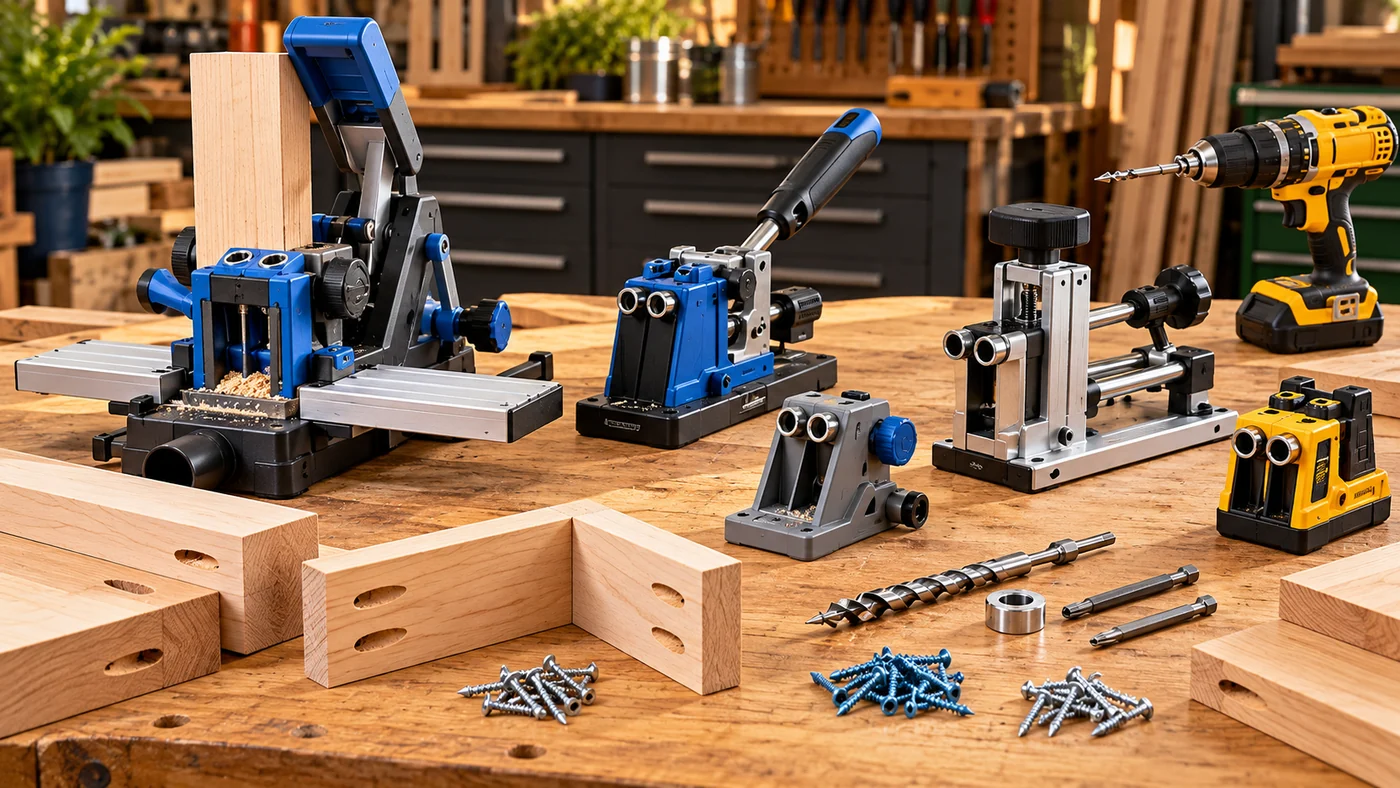
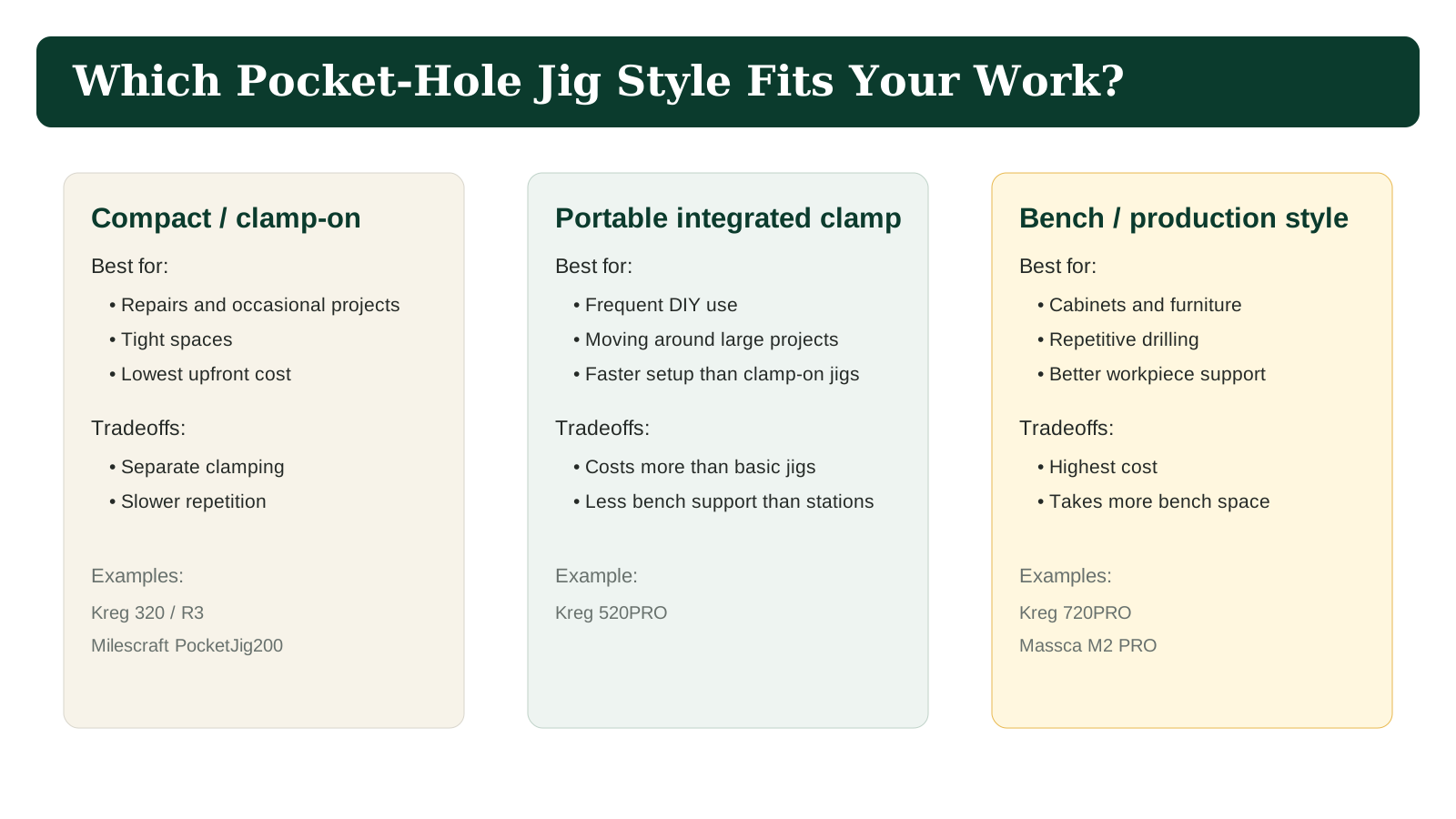
The biggest buying decision is not brand—it is workflow. If you drill four pocket holes a month, a compact $30–$40 jig may be all you need. If you build cabinets or furniture regularly, an integrated clamp or automatic-thickness bench jig can save enough setup time to justify spending $100–$150.
Quick Comparison
| Model | Observed price | Style | Notable features | Review snapshot |
|---|---|---|---|---|
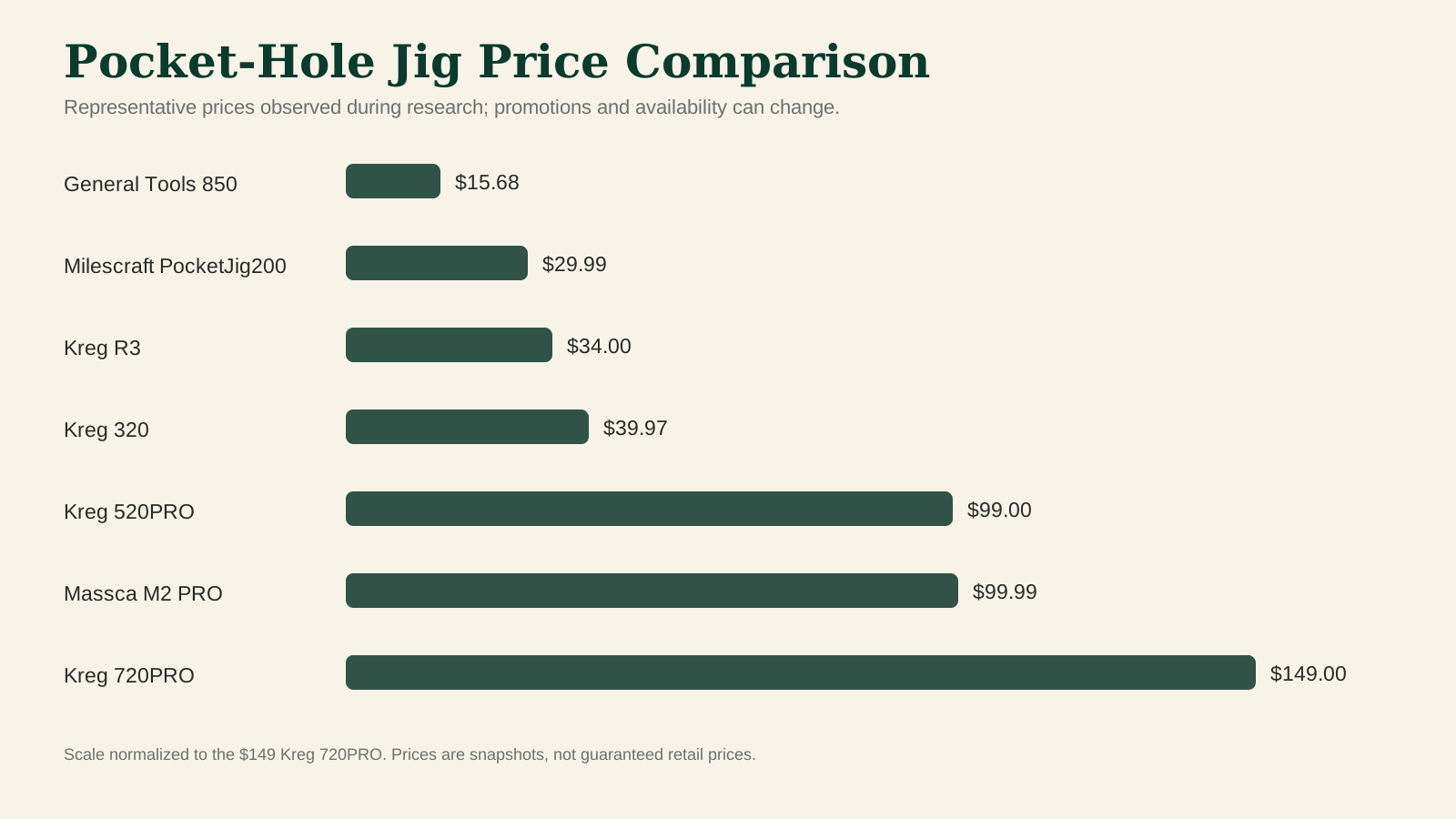
| Kreg 720PRO | $149 | Bench / production | Automaxx automatic thickness clamping, docking station, dust collection, material support | 4.6/5 from 180 Home Depot reviews |
| Massca M2 PRO | $99.99 | Bench / aluminum | Aluminum body, triple pilot holes, stabilizing bars, support stops, dust port, portable adapter | 4.9/5 from 178 Massca reviews |
| Kreg 520PRO | $99–$109 | Portable integrated clamp | VersaGrip pump-action clamping, rotating handle, GripMaxx surface | 4.7/5 from 46 Lowe's reviews |
| Kreg 320 | $39.97–$39.99 | Compact modular | Two drill guides, removable spacer, compact form, 1/2–1-1/2 in. materials | 4.7/5 from 784 Home Depot reviews |
| Kreg R3 | $34 | Compact clamp-on | Simple portable repair/project jig | 4.7/5 from 886 Home Depot reviews |
| Milescraft PocketJig200 | $29.99 | Compact kit | Four built-in thickness settings, magnetic clamp pocket, case, screws, plugs, drivers | 5.0/5 from 9 Milescraft reviews; 4.5/5 from 26 Home Depot reviews |
| General Tools 850 | $15.68 | Budget aluminum kit | Aluminum body, screws/dowels/case included | 3.9/5 from 106 Home Depot reviews |
Kreg 720PRO
Observed price: about $149.
The 720PRO is built for repetitive project work. Its main advantage is Kreg’s Automaxx clamping system, which clamps the workpiece and automatically adjusts for material thickness from 1/2 to 1-1/2 inches. The PRO package also includes the docking station, material-support wings and onboard accessory storage.
Strengths
- Very fast repeated setup.
- Automatic thickness compensation reduces adjustment steps.
- Integrated dust collection helps control chips.
- Support wings make long boards easier to manage.
Owner-review themes
Kreg’s own review highlights repeatedly praise ease of use and speed. One long-term user said a process that formerly took roughly 20 minutes with a single clamp dropped to about 5 minutes. Positive comments also mention automatic thickness adjustment. Some owners criticize the support-wing connectors and the amount of polymer used for a premium-priced jig.
Best fit: frequent furniture, cabinet and project builders who value speed more than compact storage.
Massca M2 PRO
Observed price: $99.99 direct from Massca.
The M2 PRO takes a different approach: a substantial aluminum body, hardened steel drill guides, stabilizing bars, adjustable support blocks, a dust port and a portable base adapter. The latest version uses three pilot holes.
Strengths
- Metal construction feels substantial on the bench.
- Support bars and stops are useful for repeated parts.
- Drill-guide section can be removed for portable work.
- Dust port and T-track add workshop flexibility.
Owner-review themes
Massca’s current product listing shows a 4.9/5 rating from 178 reviews. The recurring attraction is the heavy-duty aluminum construction and stability compared with lighter polymer designs.
Best fit: woodworkers who prefer an aluminum bench jig and want good repeatability for around $100.
Kreg 520PRO
Observed price: roughly $99–$109.
The 520PRO is a portable integrated-clamp jig. Its VersaGrip pump-action handle lets you clamp, drill, release and move along a large workpiece without separately repositioning a face clamp each time. The handle rotates 360 degrees, which helps when working around assembled projects.
Why choose it
- Much faster than a basic clamp-on jig.
- More portable than a 720PRO-style bench station.
- Useful for large panels or work that cannot easily come to the bench.
Lowe’s current listing shows a 4.7/5 rating from 46 reviews.
Best fit: the woodworker who wants speed but does not want a permanent bench station.
Kreg 320
Observed price: about $39.97–$39.99.
The 320 is one of the strongest all-around starting points because it is compact, modular and inexpensive. It uses two drill guides and a removable spacer, and it is designed for common material thicknesses from 1/2 to 1-1/2 inches.
Why choose it
- Easy to store.
- Works well for repairs and occasional projects.
- Can be clamped in tight or awkward locations.
- Large installed review base.
Home Depot currently shows a 4.7/5 rating from 784 reviews, while Lowe’s lists a comparable 320 package at 4.6/5 from 288 reviews.
Best fit: first-time pocket-hole users and DIYers who want a proven system without spending $100+.
Milescraft PocketJig200
Observed price: $29.99 direct from Milescraft and at Home Depot during research.
This kit stands out for how much is included. It provides four built-in thickness settings, a magnetic clamp pocket, hardened steel bushings, drill bit, stop collar, quick connector, two Torx drivers, screws, plugs and a molded case.
Review themes
Milescraft currently displays a 5.0/5 average from 9 owner reviews. Comments repeatedly mention value, build quality, tight joints and the usefulness of the storage case. Home Depot shows 4.5/5 from 26 reviews.
Best fit: value-focused buyers who want a nearly complete starter kit in a case.
Kreg R3 and General Tools 850
Kreg R3
At roughly $34, the R3 remains a popular clamp-on choice for repairs and home projects. Its biggest advantage is maturity: Home Depot lists 4.7/5 from 886 reviews, one of the largest review counts in this group.
General Tools 850
At an observed $15.68, it is the lowest-cost option in this comparison and includes an aluminum jig, screws, dowels and a storage case. The tradeoff is a lower current review score—3.9/5 from 106 Home Depot reviews.
Best fit: R3 for proven compact use; General Tools 850 for the smallest possible budget.
Features That Matter Most
| Feature | Why it matters | Worth paying more for? |
|---|---|---|
| Integrated clamping | Reduces setup time on every hole. | Yes for frequent use. |
| Automatic thickness adjustment | Removes another setup step when board thickness changes. | Most valuable for repetitive work. |
| Metal body | Adds weight and bench stability. | Preference rather than necessity. |
| Dust collection | Pocket-hole drilling produces a surprising amount of chips. | Useful in indoor shops. |
| Support wings/stops | Helps with long boards and repeatable part positioning. | Very useful for cabinet/furniture work. |
| Modular guides | Lets a jig fit tight spaces and unusual repairs. | Yes if portability matters. |
| Case/accessories | Keeps bit, collar, drivers and screws together. | High convenience value for occasional users. |
Material Thickness and Screw Length
Pocket-hole systems depend on matching drill depth and screw length to the stock thickness. Many mainstream jigs are designed around common 1/2-inch, 3/4-inch, 1-inch and 1-1/2-inch material. Follow the jig manufacturer’s chart rather than guessing.
As a general buying rule, make sure the system you choose handles the stock you actually use. Cabinet builders working mostly in 3/4-inch plywood have different needs from someone building 2x4 shop fixtures.
Screw head and thread matter too
- Coarse thread: commonly used in softwoods, plywood and MDF.
- Fine thread: often preferred for dense hardwoods where aggressive threads may split material.
- Washer/pan-style pocket-hole head: seats against the pocket shoulder rather than countersinking too deeply.
What You Need Besides the Jig
- A drill with enough chuck capacity for the supplied stepped bit.
- Correct pocket-hole screws.
- A face clamp or workholding method for compact jigs.
- Reliable board-thickness measurement.
- Spare stepped drill bits if you do a lot of work.
- Dust extraction if using a jig with a port.
- Glue when the joint design benefits from it.
- Clamps to hold the final assembly square while screws are driven.
Common Complaints Across Pocket-Hole Systems
Chip buildup
Pocket drilling creates dense chips that can pack around the bit. Dust ports and frequent bit withdrawal help.
Clamp movement
Basic jigs depend heavily on a good face clamp. Any movement while drilling can enlarge or misalign the pocket.
Stop-collar mistakes
Incorrect bit depth is one of the easiest ways to create a weak joint or drill too deeply.
Premium jigs are bulky
Bench systems work quickly but occupy far more storage and workbench space than a compact jig.
Polymer vs metal debates
Some buyers prefer heavy aluminum; others value lighter polymer designs because hardened steel guides are the critical wear surfaces.
Visible pocket holes
The joint is structurally convenient but leaves an angled hole that may require plugs or strategic placement on hidden surfaces.
When Pocket Holes Are a Great Choice
- Face frames and cabinet carcasses.
- Shop furniture and storage.
- Table aprons and hidden furniture joints.
- Edge-to-edge panel alignment where screws are hidden underneath.
- Repairs where you can reach only one side of the joint.
- Fast prototypes and utility builds.
When they are less ideal
- Highly visible fine furniture where concealed traditional joinery matters.
- Joints exposed to heavy racking loads without adequate design support.
- Very thin stock outside the jig’s rated range.
- Outdoor assemblies using the wrong screw coating or wood species.
Other Joinery Options to Consider
| Method | Advantages | Tradeoffs | Good for |
|---|---|---|---|
| Dowels | Hidden, inexpensive, strong when aligned well | Layout and drilling accuracy matter | Furniture, panels, edge joints |
| Biscuits | Fast alignment for panels and frames | Requires biscuit joiner; not always a primary structural fastener | Panel alignment, face frames |
| Loose tenons / Domino-style joinery | Fast, strong, concealed and very repeatable | Much higher tool cost | Fine furniture and production work |
| Mortise-and-tenon | Traditional, strong and elegant | More time and skill | Tables, chairs, fine furniture |
| Confirmat screws | Strong in sheet goods, simple setup | Visible fastener heads | MDF and particleboard cabinetry |
| Brackets / corner hardware | Very simple and removable | Visible hardware, bulkier joint | Utility projects and knock-down builds |
Which Price Level Makes Sense?
| Budget | What you get | Who it suits |
|---|---|---|
| Under $40 | Compact jig, separate clamp, basic accessories | Occasional DIY, repairs, first pocket-hole tool |
| $40–$100 | More accessories or integrated clamping; better portability/speed | Frequent DIY and hobby woodworking |
| $100–$150+ | Bench-style support, automatic clamping or heavy aluminum construction | Cabinetry, furniture and repeated project work |
Practical Buying Advice
For occasional projects, a Kreg 320, R3 or Milescraft PocketJig200 can do the same basic joinery job as a premium system. Spending more mainly buys speed, workpiece support, integrated clamping, dust control and repeatability—not a fundamentally different joint.
What to Compare
- How often you will use it.
- Material thickness range.
- Whether you need portability.
- Clamp speed.
- Bench space.
- Included screws and accessories.
- Availability of replacement bits and guides.
Related Workshop Guides
Research Sources & Methodology
Prices and review counts were checked against manufacturer pages and current retailer listings in September 2026. Ratings are snapshots and can change as additional reviews are posted. Product descriptions were cross-checked against manufacturer feature lists where available.
- Kreg — 720PRO specifications and owner reviews
- Kreg — 520PRO specifications
- Kreg — 320 specifications
- Massca — M2 PRO specifications, pricing and reviews
- Milescraft — PocketJig200 specifications, pricing and reviews
- Home Depot — Kreg 720PRO rating and price
- Home Depot — Kreg 320 rating and price
- Home Depot — Kreg R3 rating and price
- Home Depot — PocketJig200 retailer rating
- Home Depot — General Tools 850 rating and price