
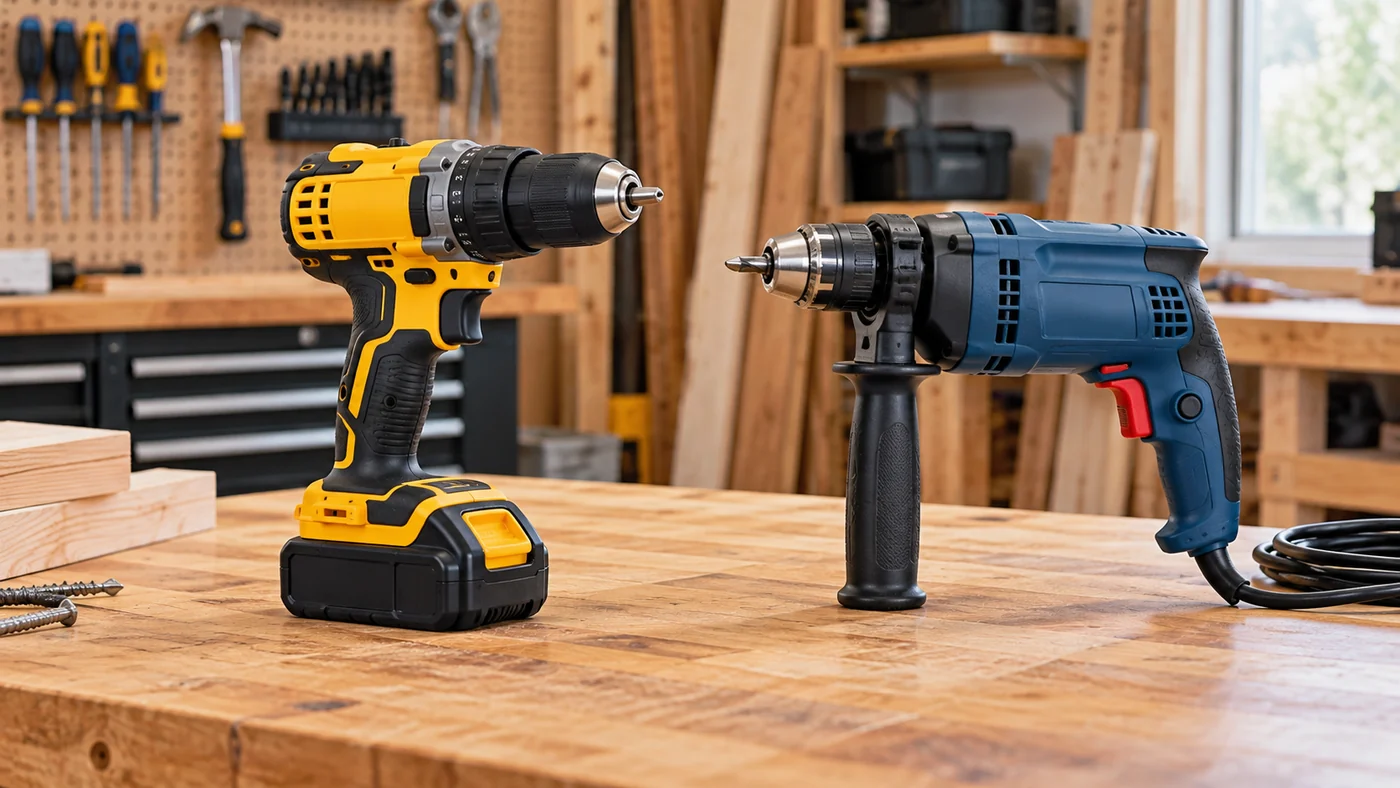
The modern cordless drill is no longer the weak, short-lived compromise it once was. This cordless vs. corded drill comparison focuses on the features that matter most when choosing the best drill for home use, DIY projects and workshop jobs. Current 18-volt and 20-volt-class lithium-ion tools can handle almost every routine drilling and driving job in a home workshop. But a corded drill still offers something batteries cannot: unlimited runtime, consistent full-power operation and a low purchase price without a battery platform commitment.
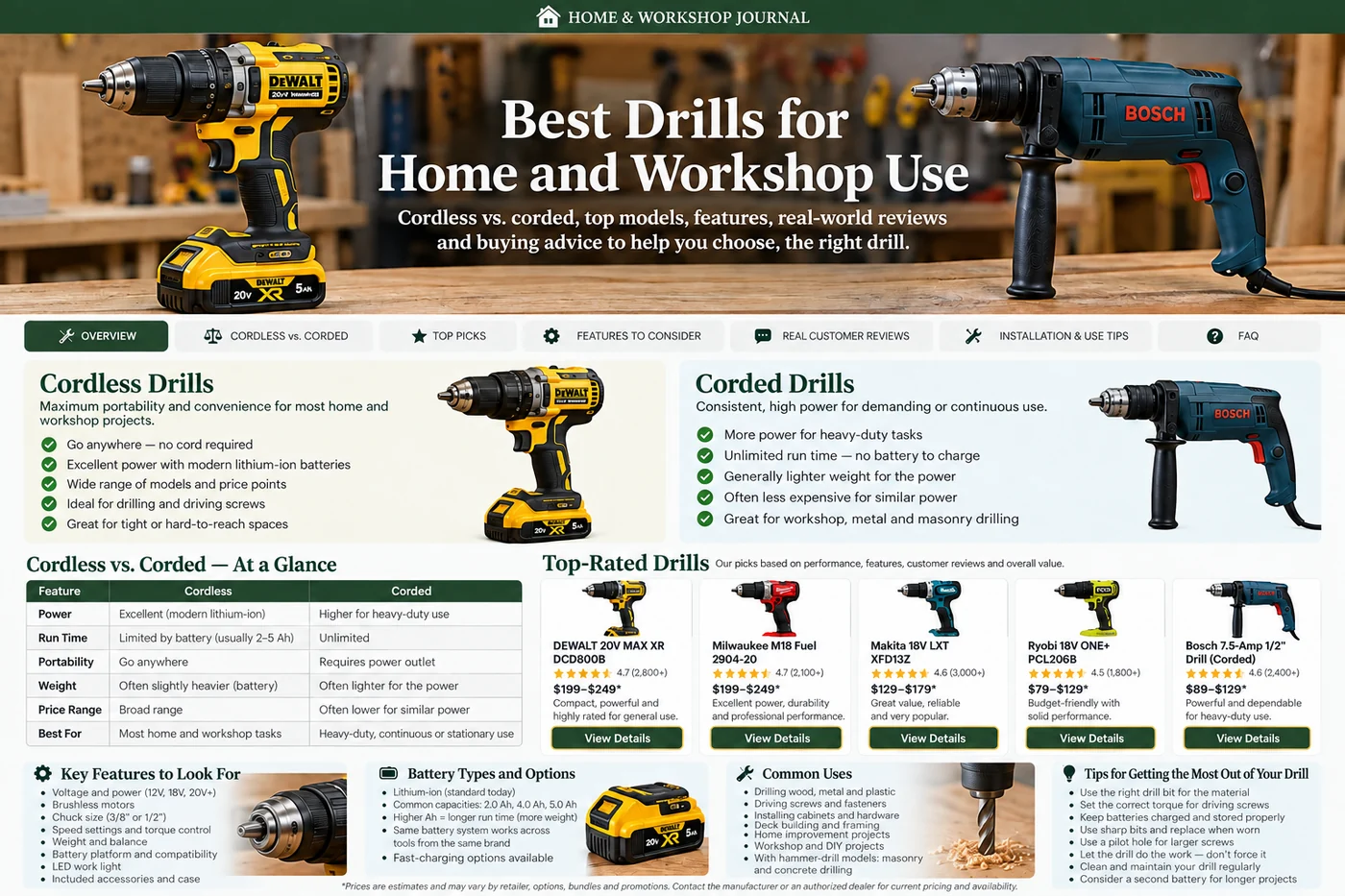
Cordless vs. Corded: The Big Differences
| Feature | Cordless | Corded / plug-in |
|---|---|---|
| Mobility | Excellent — no outlet or extension cord needed. | Limited by outlet and cord length. |
| Runtime | Limited by battery capacity, but spare packs solve most interruptions. | Effectively unlimited while power is available. |
| Power consistency | Modern brushless models stay strong under load, but battery state and pack size matter. | Consistent line power throughout the job. |
| Weight | Battery adds weight, especially with 4–6Ah packs. | Often lighter at the tool because there is no battery. |
| Convenience | Best for ladders, cabinets, garages, outdoors and quick jobs. | Best at a bench or fixed work area. |
| Ownership cost | Higher if you need batteries and charger; lower if you already own the platform. | Usually inexpensive and no battery replacement expense. |
| Long-term ecosystem | Battery choice can tie you to a broader brand platform. | No platform lock-in. |
| Typical homeowner use | Usually the better all-around choice. | Useful second drill or budget/specialty option. |
Why Cordless Usually Wins Today
Cordless drills dominate because they combine strong performance with freedom of movement. A compact 18V or 20V-class brushless drill can drive screws, drill wood and metal, install hardware and handle many hole-saw applications without the inconvenience of a cord.
The battery platform matters as much as the drill
Once you own several batteries, a charger and other tools in one system, a bare drill becomes much less expensive. This is why choosing between DeWalt 20V MAX, Milwaukee M18, Makita 18V LXT, Ryobi ONE+ or another ecosystem is a long-term decision rather than a one-tool decision.
Battery size changes the feel of the tool
A compact 1.5–2.0Ah battery keeps a drill light and nimble. A 4.0–5.0Ah pack provides longer runtime and can sometimes support higher output, but adds weight. Large packs make sense for repetitive hole drilling; smaller packs are often nicer for cabinet hardware and overhead work.
Performance at a Glance
The ratings below are an editorial comparison of the two power-source categories, not laboratory test results. They show how the technologies tend to compare for typical home and workshop use.
Representative Drills to Compare
| Model | Power / key features | Observed price | Consumer review snapshot | Where sold |
|---|---|---|---|---|
| DeWalt DCD800B 20V MAX XR cordless drill/driver | Brushless; 1/2-in metal ratcheting chuck; 2 speeds, 0–650 / 0–2,000 RPM; 6.37-in head length; adjustable LED. Tool only. | About $181 at a major home-improvement retailer during research. | Retailer listing showed more than 300 review/Q&A interactions. Owners commonly value the compact size, strong drilling performance and bright LED; bare-tool buyers should remember battery and charger are extra. | DeWalt direct, major home-improvement retailers and tool dealers. |
| Milwaukee 2904-20 M18 FUEL 18V cordless hammer drill/driver | Brushless; 1/2-in chuck; 6.9-in tool length; up to 1,400 in-lb published torque; hammer mode; anti-kickback/control electronics. | About $229 tool-only; promotional bundles vary significantly. | Retailer product data showed about 4.7/5 from roughly 1,677 reviews. Common positives are power and compactness; the recurring tradeoff is weight and price compared with lighter homeowner drills. | Milwaukee dealers, major home-improvement retailers and tool specialists. |
| Makita XFD14Z 18V LXT cordless drill/driver | Brushless; 1/2-in all-metal chuck; 0–550 / 0–2,100 RPM; 1,250 in-lb published max torque; 7-in length; tool only. | About $189 at specialty tool retailers during research. | Owner feedback commonly highlights smooth control, strong chuck grip and the mature LXT battery ecosystem. Its full-size premium design is heavier than subcompact alternatives. | Makita dealers, specialty tool retailers and major online sellers. |
| Ryobi PCL206K1 18V ONE+ cordless kit | 1/2-in keyless ratcheting chuck; up to 515 in-lb published torque; 0–450 / 0–1,750 RPM; battery and charger included in common kit. | About $89 for a one-battery kit during research. | Major-retailer listing showed about 4.7/5 from more than 4,000 reviews. Owners frequently praise value, simplicity and access to the large ONE+ system; premium brushless drills offer more power and refinement. | Ryobi direct and major home-improvement retailers. |
| Ryobi D43K 5.5A corded 3/8-in drill/driver | 5.5-amp motor; 3/8-in keyless chuck; variable speed; 6-ft cord; bag included. | $59 during research. | Retailer reviews showed about 4.5/5 from roughly 1,669 reviews, with 91% recommending. Positive themes include reliability, low cost, light weight and not having to manage batteries. | Major home-improvement retailers and Ryobi channels. |
| Bosch 1006VSR 6.3A corded 3/8-in drill | 6.3-amp motor; 3/8-in Jacobs ratcheting keyless chuck; variable speed up to about 2,600 RPM; compact pistol-grip design. | About $59–$112 in current online listings, depending on seller. | Review volume is lower in current listings than the Ryobi corded model, but the appeal is similar: simple line-powered drilling with no battery ecosystem. | Tool dealers and online industrial/tool retailers. |
What the Specifications Actually Mean
Voltage
Voltage tells you the battery platform, not how good the drill is. In the U.S., many “20V MAX” tools are based on cells with an 18V nominal pack voltage; the 20V figure is maximum initial voltage. That means 18V and 20V-class tools often compete in the same performance category.
Torque
Torque is useful but difficult to compare across brands because manufacturers may use different test methods and ratings. High torque matters for large auger bits, hole saws and big fasteners; it matters far less for installing cabinet pulls.
RPM and gearing
Two-speed gearboxes are valuable. Low gear provides greater mechanical advantage for large bits and high-load driving; high gear speeds up smaller drilling work.
Chuck size
A 1/2-inch chuck is the standard choice for a serious all-purpose drill. Compact 3/8-inch chucks are fine for lighter homeowner tasks but limit large-shank accessories.
Clutch settings
The clutch controls how much torque the drill applies before slipping. This is especially useful when driving screws without stripping heads or burying fasteners too deeply.
Cordless and Corded Drill Reviews: What Owners Tell Us
Convenience drives satisfaction
Cordless owners repeatedly praise being able to grab the drill and work immediately. The absence of a cord is particularly valuable for ladders, cabinets, fences and outdoor jobs.
Battery ecosystems shape future purchases
Once owners accumulate two or three batteries, they tend to stay within that brand because bare tools become cheaper. This can be more important than a small difference in drill specifications.
Compactness matters more than headline power
Reviewers of premium compact drills such as the DeWalt DCD800 and Milwaukee 2904 often mention how much easier a shorter drill is between studs, inside cabinets and in tight corners.
Corded owners like “always ready” simplicity
Reviews of the Ryobi D43K specifically praise not worrying about battery charge, the light feel and dependable power for household jobs.
Heavy batteries can erase the compact advantage
A drill may have a small head but become tiring with a large 5Ah or 6Ah pack. For light work, a compact battery is often the better ergonomic choice.
Review counts need context
Retailer ratings can combine variants, kits or syndicated manufacturer reviews. Use them to identify recurring ownership themes, not as a substitute for specifications or hands-on testing.
Which Drill Type Fits Which Job?
| Job | Better fit | Why |
|---|---|---|
| Furniture assembly and cabinet hardware | Compact cordless | Easy handling, clutch control and no cord around finished surfaces. |
| General household repairs | Cordless | Fastest to grab and use anywhere. |
| Building shelves and workbenches | Cordless | Mobility and enough power for most wood drilling and fastening. |
| Repeated drilling at a stationary bench | Corded or cordless | Corded offers unlimited runtime; cordless is still more convenient. |
| Large hole saws / auger bits | High-torque cordless or heavy-duty corded | Choose adequate low-speed torque and side-handle/control features. |
| Masonry drilling | Hammer drill or rotary hammer | A standard drill/driver is not the right tool for substantial concrete work. |
| Occasional use after long storage | Corded | No aging battery to maintain. |
| Outdoor fence or deck work | Cordless | No extension cord and much easier movement. |
Drill/Driver, Hammer Drill or Impact Driver?
These tools overlap but are not the same.
- Drill/driver: the general-purpose choice for drilling holes and driving screws. It has a clutch and conventional chuck.
- Hammer drill/driver: adds a rapid hammering action for occasional drilling in masonry. It can still be used as a normal drill/driver with hammer mode switched off.
- Impact driver: uses rotational impacts and a 1/4-inch hex collet. It excels at long screws and structural fasteners but is not a substitute for a drill when using conventional round-shank bits.
- Rotary hammer: the specialist choice for frequent or larger concrete drilling. It uses an SDS-type mechanism and is substantially more effective in masonry.
Battery Buying: 2Ah vs. 5Ah and Beyond
Amp-hours are a measure of battery capacity, not simply “power.” Higher-capacity packs usually run longer and may deliver higher current because they contain more cells or newer cell designs, but they are also larger and heavier.
| Battery size | Best use | Tradeoff |
|---|---|---|
| 1.5–2.0Ah | Light drilling, hardware, cabinetry, overhead work | Shorter runtime, but excellent balance and low weight |
| 3.0–4.0Ah | General DIY and mixed drilling | Good compromise between runtime and weight |
| 5.0Ah+ | Large holes, repetitive drilling, long work sessions | Heavier and bulkier |
Keep lithium-ion batteries out of extreme heat when possible. Avoid storing them completely depleted for long periods, and use the manufacturer’s charger and compatible packs.
Safety and Use Tips
Large bits can bind suddenly. A side handle gives you better leverage and helps control reaction torque.
High speed is not always better. Large augers, spade bits and hole saws need lower RPM and greater torque.
Excessive pressure overheats bits and motors. A sharp bit with the correct speed should remove material without being forced.
Small metal and wood pieces can spin violently if a bit catches.
Follow the manual, especially when servicing or clearing a jam.
For corded tools, use a properly rated extension cord and replace damaged cords rather than taping over cuts.
Wood chips, metal spirals and broken bits can be hazardous.
Before drilling walls, know where electrical wiring and plumbing may run.
Best Drill for Home Use: What to Look For
- 18V or 20V-class platform with batteries you can use in other tools
- Brushless motor if budget allows
- 1/2-inch ratcheting chuck
- Two-speed gearbox
- Variable-speed trigger
- Useful clutch range
- Good low-speed trigger control
- Compact head length
- LED that actually illuminates the bit
- Kit with two batteries if the price premium is reasonable
Buying Mistakes to Avoid
- Buying based only on torque: balance, trigger control, chuck quality and ergonomics matter every time you use the tool.
- Ignoring battery cost: a cheap bare tool is not cheap if you must buy a battery and charger separately.
- Choosing a platform with no future plan: batteries become more valuable when they also power saws, sanders, lights, blowers and outdoor tools you may eventually buy.
- Using a drill as an impact driver: long structural screws can be much easier with the right impact tool.
- Assuming hammer mode replaces a rotary hammer: it does not for frequent concrete drilling.
- Buying too large a drill: a premium high-torque model can be tiring for simple homeowner work.
The Bottom Line
For most homes and workshops, a modern cordless 18V/20V-class drill-driver is the most practical choice. It is powerful enough for the majority of drilling and fastening tasks, easy to carry and much more convenient for quick jobs.
A corded drill remains useful when low purchase price, unlimited runtime and long-term simplicity matter more than mobility.
Before You Buy
- Decide whether you are buying one drill or entering a battery platform.
- Compare kit price with bare-tool price plus batteries.
- Handle the drill with the battery installed if possible.
- Choose battery size based on the work, not just maximum capacity.
- Look for a 1/2-inch chuck and two-speed gearbox for general workshop use.
- Check current pricing and warranty through the manufacturer or authorized dealer.
Related Workshop Guides
If you are building out a home workshop, these guides cover two of the next tool decisions many DIYers face:
Research Sources & Methodology
This article cross-checked current manufacturer specifications, major-retailer pricing, customer-review pages and tool listings. Prices, promotions, bundles, review counts and availability change frequently. Contact the manufacturer or an authorized dealer for current pricing and availability.
- DeWalt — DCD800B specifications
- Milwaukee — M18 FUEL 2904-20 product information
- Makita — XFD14Z specifications
- Ryobi — PCL206 18V ONE+ drill/driver specifications
- Major-retailer listing — DeWalt DCD800B current pricing/reference
- Major-retailer listing — Milwaukee 2904-20 customer reviews/reference
- Major-retailer listing — Ryobi PCL206K1 customer reviews/reference
- Major-retailer listing — Ryobi D43K corded drill pricing/reviews
Editorial note: Retailer ratings can include syndicated reviews, bundles and closely related variants. We use them to identify recurring ownership themes, not as a substitute for independent performance testing. Manufacturer output claims are presented as manufacturer specifications rather than as our own test results.