
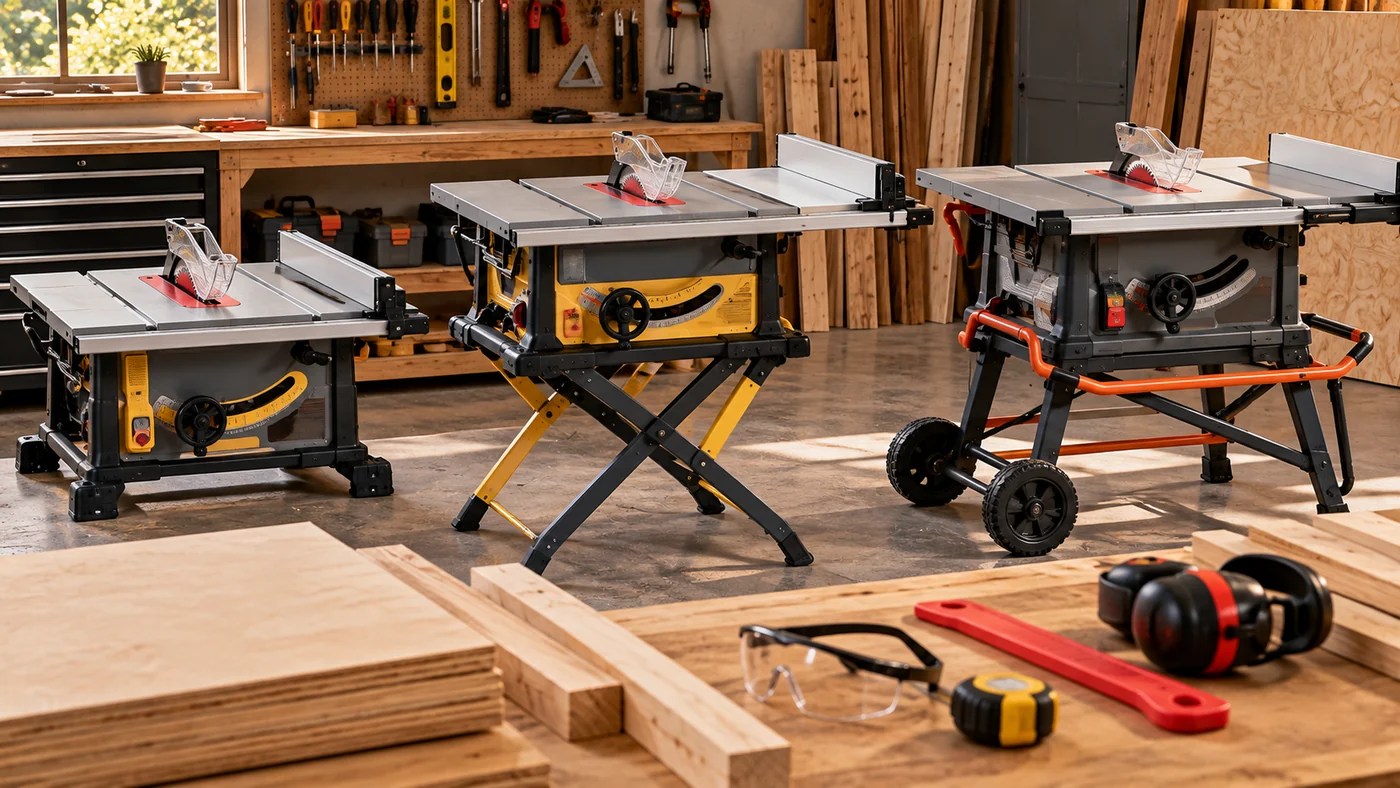
The best table saw under $500 depends on what you value most. For many homeowners, DIYers and beginning woodworkers, the best table saw for home use does not need to cost $1,000. A compact 8-1/4-inch saw can be easier to store and carry, while a 10-inch saw gives you deeper cuts, wider blade availability and—in some models—dado capability. For a home workshop, the fence and stand often matter as much as raw power.
Best Table Saws Under $500 at a Glance
| Model | Observed price | Blade | Rip capacity | Stand | Best fit |
|---|---|---|---|---|---|
| Ryobi RTS12 | About $229 | 10 in. | Check current spec listing | Folding stand included | Lowest-cost starter saw |
| SKIL TS6307-00 | $329.99 | 10 in. | 25.5 in. right | Integrated folding stand | Best balance of features and price |
| RIDGID R4518 | About $359 | 10 in. | 27 in. | Folding stand included | Home-shop capacity + service agreement |
| DeWalt DWE7485 | About $429 saw-only; bundles vary | 8-1/4 in. | 24.5 in. | Usually separate on saw-only SKU | Compactness and fence refinement |
About $229
10-inch + stand
27-inch rip
24.5-inch rip
What $500 Buys Today
Most table saws in this price class are portable or jobsite-style machines rather than heavy cast-iron contractor or cabinet saws. That means you should expect an aluminum table, direct-drive motor, compact footprint and some compromise in mass and vibration damping. What has improved dramatically is the quality of fences, portable stands and safety systems.
A good sub-$500 saw can be accurate enough for cabinetry, shelving, furniture components and general home-shop work when it is properly aligned and fitted with an appropriate blade. The practical limitations are usually table size, stability with large sheets, noise, dust collection and the quality of the supplied miter gauge.
Feature Comparison: What Matters Most
These are editorial comparison scores based on published specifications, included equipment, observed pricing and recurring owner-review themes—not laboratory test results.
SKIL TS6307-00: Strongest Value Package
The SKIL TS6307-00 is unusually complete for the money and is our strongest candidate for the best table saw for the money in this price range. It uses a 15-amp motor, a full 10-inch blade and a rack-and-pinion fence system, and its legs fold into the saw rather than requiring a separate stand.
- Observed price: $329.99 direct from SKIL.
- Rip capacity: 25.5 inches right of blade.
- Cut depth: 3.5 inches at 90° and 2.5 inches at 45°.
- Dado capacity: up to 5/8 inch with the proper insert and setup.
- Speed: 4,600 RPM.
- Stand: integrated folding legs.
Owner-review themes
Buyers commonly praise the combination of price, 10-inch cutting capacity and the integrated stand. The rack-and-pinion fence is also repeatedly cited as easier to set than older clamp-style fences. Recurring tradeoffs are the lighter jobsite construction, compact table size and the need to check alignment during initial setup.
RIDGID R4518: More Rip Capacity With a Stand
The R4518 is a 10-inch, 15-amp jobsite saw with a folding stand and a published 27-inch rip capacity. RIDGID also advertises a blade brake that stops the blade in fewer than four seconds.
- Observed price: about $359.
- Rip capacity: 27 inches.
- Speed: 5,000 RPM.
- Stand: folding stand included.
- Support: eligible for RIDGID's Lifetime Service Agreement when registered according to the program terms.
Owner-review themes
Owners commonly like the included stand, 10-inch blade format and broad capacity for home projects. Recurring criticisms on portable RIDGID saws tend to center on setup, fence/miter-gauge refinement and the fact that the larger package is less convenient to carry than a compact benchtop saw.
10-Inch vs. 8-1/4-Inch Table Saws
| Question | 8-1/4 in. | 10 in. |
|---|---|---|
| Portability | Usually lighter and more compact | Usually larger/heavier |
| Maximum cut depth | Lower | Higher; some can cut 4x4 material at 90° |
| Blade selection | Good, but narrower | Very broad |
| Dado capability | Often not supported | Available on selected models |
| Storage | Excellent for small garages | Requires more room |
| General DIY | Excellent | Excellent |
If you work mostly with 3/4-inch plywood and dimensional lumber up to 2x material, an 8-1/4-inch saw can be completely adequate. If you expect to use dado stacks or cut thicker stock regularly, a 10-inch model makes more sense.
Two Jobs That Show the Difference
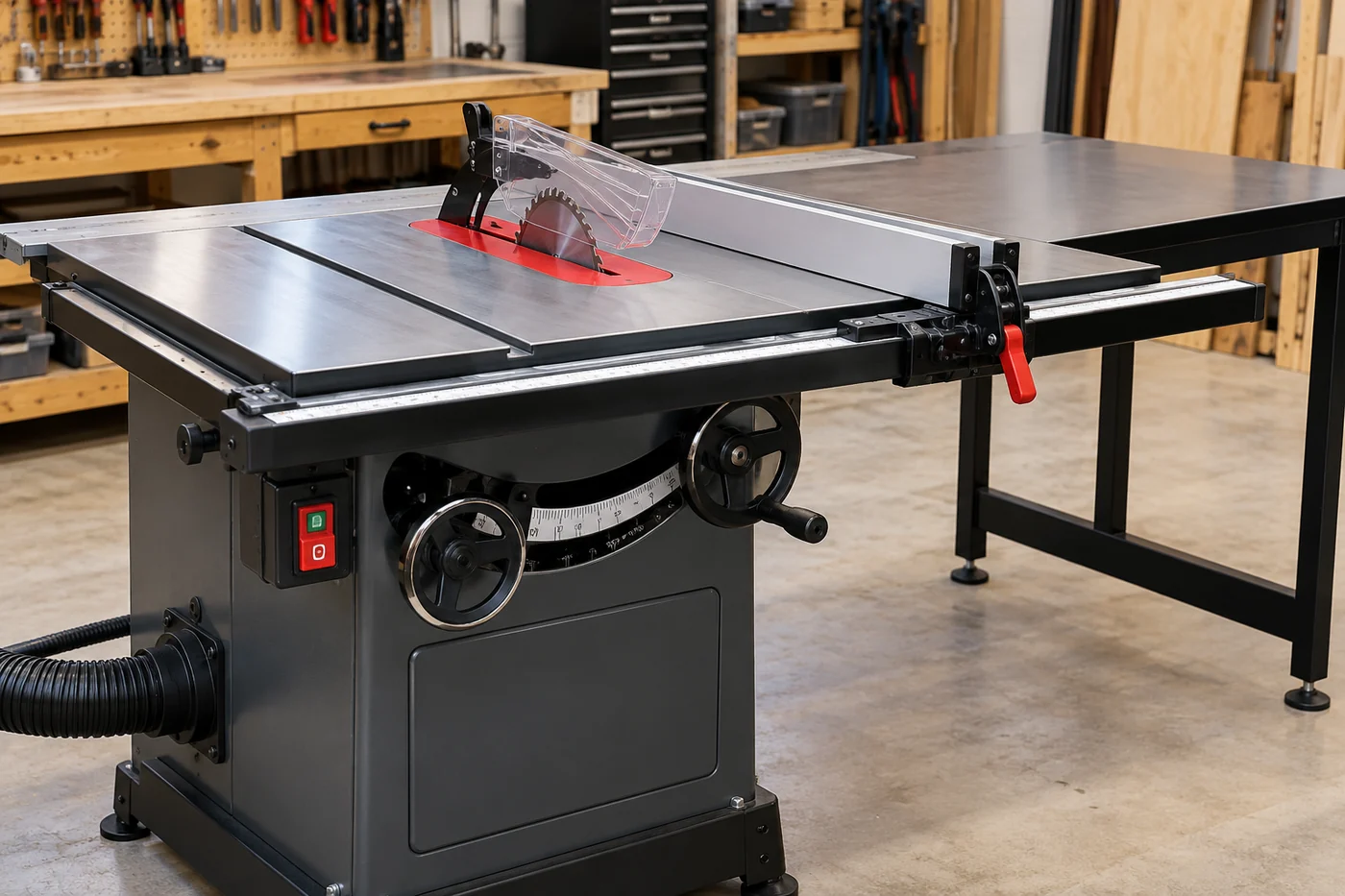
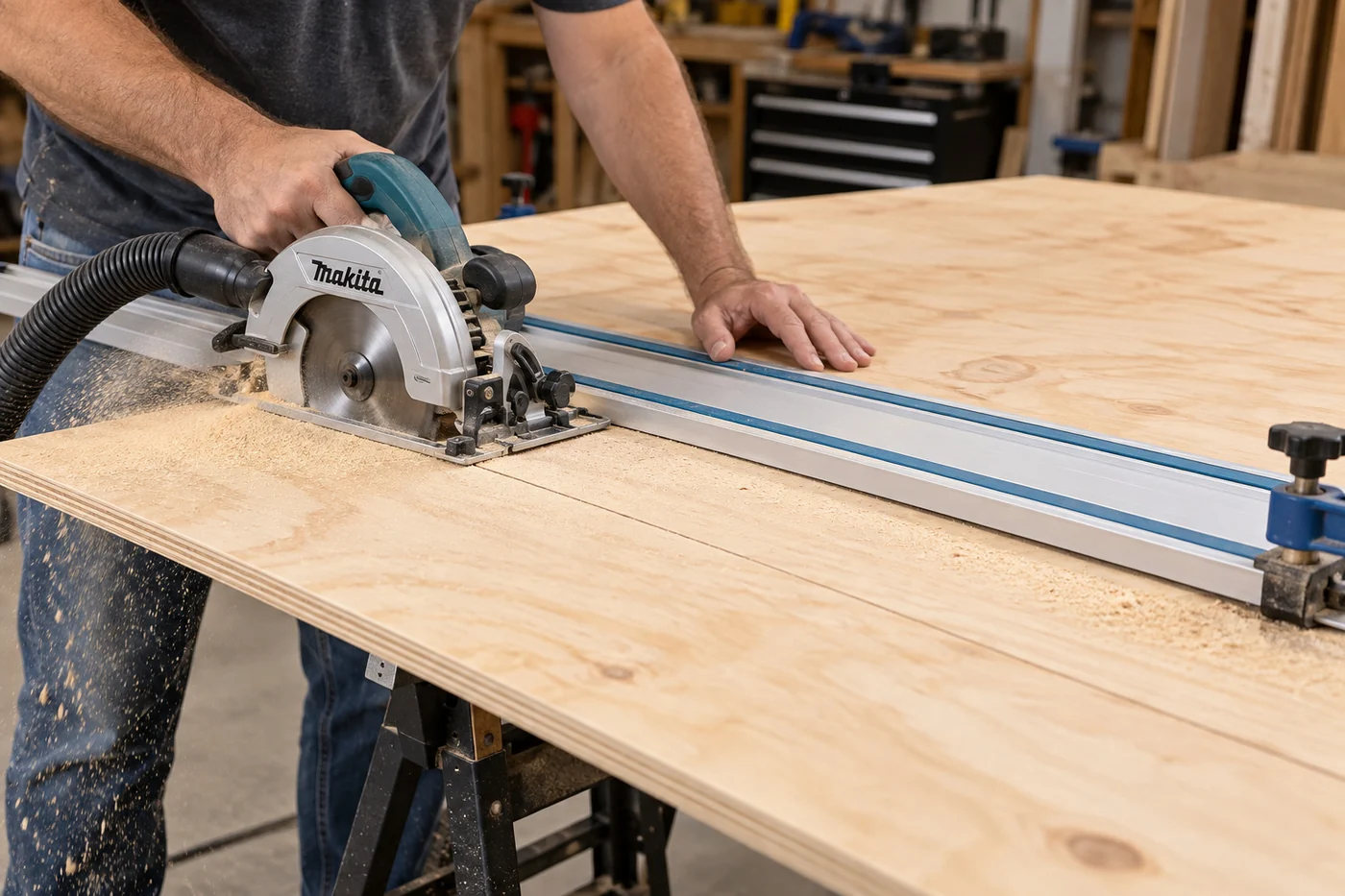
Fence Quality Matters More Than Most Buyers Expect
A table saw can have plenty of power and still be frustrating if the fence is difficult to position parallel to the blade. Rack-and-pinion systems, such as those on the DeWalt and SKIL models, move both ends of the fence together and are popular because they make small, repeatable adjustments easier.
Whatever style you buy, verify that the fence locks parallel to the blade and does not deflect noticeably when moderate side pressure is applied. Recheck alignment after transporting or folding the saw.
Rip Capacity: How Much Do You Actually Need?
Rip capacity is the distance between the blade and the fence at its widest setting. Around 24–27 inches is enough to rip a 4x8 sheet in half, but that does not mean a small portable table is the easiest way to handle a full sheet safely.
| Rip capacity | Typical use |
|---|---|
| 20–24 in. | General boards, shelving, smaller panels |
| 24.5–27 in. | Can rip a 4x8 sheet roughly in half; useful homeowner range |
| 30+ in. | More cabinet/panel flexibility, but usually a larger and more expensive saw |
What Consumer Reviews Tell Us
Fence accuracy drives satisfaction
Owners are much happier with a saw when the fence moves smoothly, locks square and returns to a measurement consistently. This is one reason rack-and-pinion systems receive so much attention in the sub-$500 class.
The included blade is rarely the final blade
Stock blades are often geared toward fast construction cuts. Owners doing furniture or plywood work commonly upgrade to a 40- or 60-tooth carbide blade for cleaner results.
Portable does not mean effortless
A 45-pound benchtop saw is manageable for many users. A 60- to 100-pound saw-and-stand combination is easier to roll than to lift into a vehicle.
Miter gauges are a weak point
Budget and jobsite saws often include basic miter gauges. Owners seeking repeatable crosscuts frequently add a better gauge or build a crosscut sled.
Dust collection varies
Even saws with dust ports can throw dust from the blade opening and top of the table. Connecting a shop vacuum helps, but users should not expect cabinet-saw dust containment.
Initial alignment is worth the time
Blade-to-miter-slot alignment, fence parallelism and the 90°/45° stops should be checked before serious work. A well-adjusted affordable saw can cut far better than an expensive saw that is out of alignment.
Safety Features to Look For
- Riving knife: helps keep the kerf from closing behind the blade and reduces kickback risk.
- Blade guard: should be easy enough to install and remove that you will actually use it when appropriate.
- Anti-kickback pawls: help resist stock moving backward toward the operator.
- Large, accessible power switch: easier to shut off quickly.
- Power-loss reset: helps prevent an unexpected restart after power is interrupted.
- Blade brake: stops the blade faster after switch-off on models that include it.
- Stable stand: a saw that rocks or shifts under load is a safety problem as well as an accuracy problem.
What to Budget Beyond the Saw
| Accessory | Typical reason | Priority |
|---|---|---|
| 40T or 50T combination blade | Cleaner general-purpose cuts than many stock blades | High |
| 60T plywood / finish blade | Cleaner plywood and crosscuts | Useful |
| Push blocks / push sticks | Safer control of narrow stock | Essential |
| Eye + hearing protection | Basic table-saw PPE | Essential |
| Shop vacuum / dust hose | Improves dust capture | High |
| Outfeed support | Supports long boards and panels | High |
| Crosscut sled | More stable, repeatable crosscuts | Useful |
Best Table Saw for Home Use, Beginners and DIY Woodworking
| Buyer | Best match | Why |
|---|---|---|
| First saw, tight budget | Ryobi RTS12 | Lowest purchase price and stand included. |
| DIYer wanting the strongest value | SKIL TS6307-00 | A strong best budget table saw choice with a 10-inch blade, rack-and-pinion fence and folding stand at about $330. |
| Garage shop wanting more rip room | RIDGID R4518 | 27-inch rip capacity, 10-inch blade and stand included. |
| Small shop / frequent transport | DeWalt DWE7485 | Compact footprint, refined fence and strong portability. |
| Beginner woodworker | SKIL TS6307-00 | A practical best table saw for beginners because the fence, stand and 10-inch blade make it versatile without adding a separate stand purchase. |
| Portable home or jobsite use | DeWalt DWE7485 | Our best portable table saw choice when compact size, easy transport and a refined rack-and-pinion fence matter most. |
| Frequent dado work | SKIL TS6307-00 | Published support for dado widths up to 5/8 inch. |
Common Buying Mistakes
- Buying on motor amperage alone: most saws here are 15-amp machines; fence quality and setup matter more.
- Ignoring stand cost: a cheaper saw can become more expensive after adding a quality stand.
- Assuming a 4x8 sheet is easy to handle because the rip capacity allows it: support and control are separate issues.
- Expecting the stock blade to do everything: blade choice can transform cut quality.
- Not measuring storage space: integrated stands are convenient, but some folded saws remain bulky.
- Skipping calibration: verify blade, fence and stops before judging accuracy.
When You Should Spend More Than $500
Move above this price range if you need a larger work surface, substantially greater rip capacity, a heavier rolling stand, better dust collection, a quieter belt-drive design, or the mass and stability of a contractor/cabinet saw. You may also want to spend more if the saw will be used daily rather than occasionally.
For many homeowners, however, the better investment is to buy a well-designed sub-$500 saw and reserve part of the budget for a quality blade, dust collection and outfeed support. If you are setting up a practical home shop, our DIY workbench build shows one way to create more usable workspace without starting from scratch.
Bottom Line
If the goal is maximum capability for the money, the SKIL TS6307-00 is especially compelling because the 10-inch blade, 25.5-inch rip capacity, rack-and-pinion fence and integrated stand are all included around the low-$300 range. The DeWalt DWE7485 remains a strong choice when portability and fence refinement matter more than 10-inch blade depth. The RIDGID R4518 gives you more rip capacity and a stand, while the Ryobi RTS12 keeps the initial cost lowest.
Before You Buy
- Measure your storage space.
- Decide whether you need a 10-inch blade or dado capability.
- Include stand cost in the real purchase price.
- Plan for outfeed support on long material.
- Budget for a better blade if cut quality matters.
- Verify current price, warranty and included accessories before ordering.
Related Workshop Guides
Research Sources & Methodology
This guide cross-checked manufacturer specifications, current retailer listings and owner-review pages available on September 29, 2026. We did not conduct instrumented laboratory testing of these saws. Review commentary is presented as recurring ownership themes, and manufacturer performance claims are identified as published specifications.
- DeWalt — DWE7485 specifications and warranty
- SKIL — TS6307-00 specifications and current direct price
- RIDGID — R4518 specifications
- Ryobi — RTS12 product page and current direct price
- Major retailer — DeWalt DWE7485 current price and review count
- Major retailer — RIDGID R4518 current price and review count
- Major retailer — DeWalt owner-review themes
Editorial note: Prices, promotions, ratings and review counts change frequently. Retailer reviews can include syndicated or incentivized reviews. Use them to identify recurring owner experiences, not as a substitute for hands-on testing. Always follow the current manufacturer manual for setup, blade selection, guarding and safe operation.