
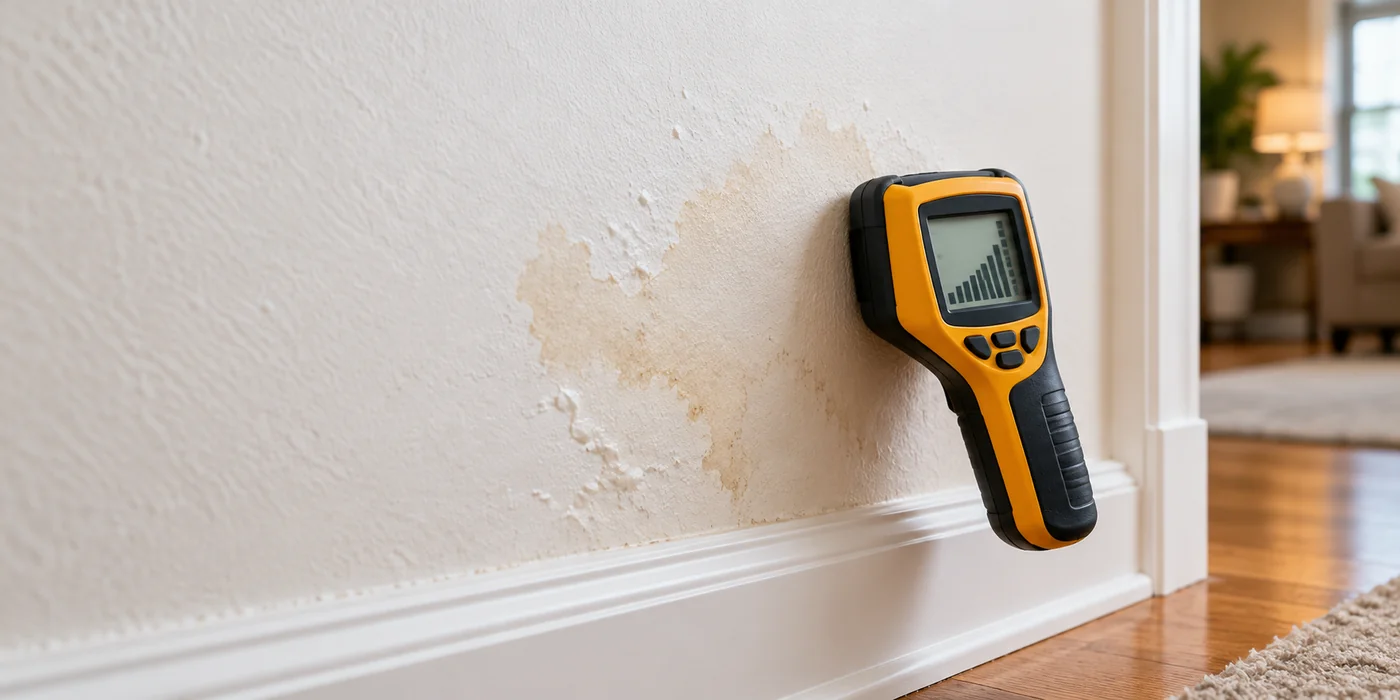
How to tell if a water leak is behind a wall usually starts with a pattern: a stain that returns, paint that bubbles, a musty smell, soft drywall, or a water meter that keeps moving when every fixture is off. The goal is to confirm that you really have a leak, rule out obvious sources, and then narrow the problem down without making a large hole in the wall too soon.
Signs a Water Leak May Be Behind the Wall
| What you notice | What it can mean | What to check next |
|---|---|---|
| Yellow or brown stain | Moisture has reached the drywall or paint. | Look directly above and on the opposite side of the wall for plumbing, a bathroom, roof penetration or HVAC drain. |
| Bubbling or peeling paint | Moisture may be trapped behind the finish. | Press gently around the area and compare with dry wall nearby. |
| Soft, swollen or crumbly drywall | The wall material has absorbed water. | Use a moisture meter and stop the source before repairing the wall. |
| Musty odor | Persistent moisture may be supporting mold growth. | Check for damp materials, especially around baseboards, cabinets and wall cavities. |
| Dripping, hissing or faint running-water sound | A pressurized supply line or drain may be leaking inside the cavity. | Listen with nearby fixtures off and compare the sound before and after shutting off the main water supply. |
| Unexpected water-bill increase | A hidden leak may be running continuously. | Perform the water-meter test below. |
How to Find a Water Leak in Your Home Before Opening the Wall
The fastest way to avoid tearing into the wrong wall is to work from broad clues to specific ones.
Can a Moisture Meter Find a Leak Behind Drywall?
A moisture meter does not directly “see” a pipe leak, but it can show where the wall is wetter than the surrounding material. That makes it useful for mapping the extent of a suspected leak.
Pinless meters are convenient because they can scan without poking holes. Pin-style meters can give more localized readings but leave tiny punctures. Either type works best when you compare multiple readings rather than relying on a single number.
Metal studs, pipes, fasteners, tile, foil-backed insulation and dense materials can affect readings, so treat the meter as evidence rather than proof.
What About a Thermal Camera?
A thermal camera can reveal temperature differences that sometimes correspond with wet insulation or evaporative cooling. It is useful for seeing patterns over a larger area, especially when the leak has spread.
But a cold or warm patch is not automatically water. Air leaks, missing insulation, sunlight, HVAC ducts and exterior temperature differences can create similar images. Use thermal imaging together with a meter test, visual signs and moisture readings.
Water Leaks in Home Walls: Where They Commonly Start
- Pressurized supply lines: a pinhole leak or failed fitting can run continuously and may be easier to confirm with the meter test.
- Shower or tub plumbing: valve bodies, shower arms, drain assemblies and failed waterproofing can wet an adjacent wall.
- Sink and appliance supply lines: small leaks behind vanities, refrigerators or washing machines can migrate into wall cavities.
- Drain and waste piping: these leaks may only appear when a sink, tub, shower or toilet is being used.
- Roof or exterior water intrusion: rain can travel along framing and appear well away from the actual entry point.
- HVAC condensate: a blocked or damaged drain can create stains that look like a plumbing leak.
How to Narrow Down Supply Leak vs. Drain Leak
| Clue | More consistent with |
|---|---|
| Water meter moves with everything off | Pressurized supply leak or another continuous water-use problem |
| Wall gets wet only when shower/sink/tub is used | Drain, fixture connection or waterproofing problem |
| Moisture appears after rain | Roof, window, flashing or exterior intrusion |
| Stain appears near HVAC equipment or drain route | Condensate issue |
| Meter stops moving after main supply is shut off | Confirms the source is connected to the domestic water system, but not its exact location |
Should You Cut Into the Wall?
Not immediately. A small inspection opening can be useful once the likely cavity is known, but opening the wall before narrowing the source can turn a small plumbing problem into a larger repair.
Before cutting, consider what may be hidden in the cavity: electrical wiring, plumbing, gas lines, ductwork and structural framing. If the suspected leak is near electrical equipment, tile, a shower valve, a load-bearing area or a difficult-to-access pipe, calling a professional first is usually the safer path.
When a Home Water Leak Detector Can Help
If you are worried about leaks when nobody is home, a home water leak detector or a broader home water leak detection system can add another layer of protection. Spot sensors alert when water reaches a specific location, while whole-home flow monitors look for unusual usage patterns. Some systems can also close a motorized shutoff valve.
Our Leak Detection for the Home guide compares spot sensors, smart home water leak sensors, whole-home monitoring and automatic shutoff options.
When to Call a Plumber or Water-Damage Professional
- The water meter shows ongoing loss but you cannot find an exposed leak.
- The wall is actively wet, swollen or deteriorating.
- Water is near electrical wiring, outlets or fixtures.
- The suspected pipe is inside a tiled shower wall, slab, ceiling or other hard-to-access area.
- You can smell persistent mustiness or see mold growth.
- The leak has affected insulation, flooring, cabinets or a large section of drywall.
Stopping the water source is only half the job. Wet materials need to be dried properly so the wall cavity does not remain damp after the plumbing repair.
Do Not Ignore Persistent Dampness
CDC notes that mold grows where moisture is present, including around leaking pipes and walls. If a wall has been wet, fixing the leak and drying the materials matters more than simply painting over the stain. Persistent moisture can continue damaging drywall, insulation, wood and finishes even when the surface looks better.
The Bottom Line
If you suspect a water leak behind a wall, start by looking for a pattern rather than reaching for a saw. Check the meter, rule out visible fixtures, map nearby plumbing, and use moisture readings to narrow the wet area. If the evidence points to a concealed supply line or the wall is actively deteriorating, shut off the water and bring in a plumber before the damage spreads.
When Should You Call a Plumber for a Water Leak?
If your water meter suggests an active leak, the wall stays damp after nearby fixtures have been ruled out, or you can hear water moving when everything is turned off, it is usually time to call a plumber for water leaks. A plumber who handles water leak detection can often narrow down the source before a large section of drywall has to be opened.
What Does a Plumber Do to Find a Hidden Water Leak?
Depending on the location and plumbing layout, a plumber may use moisture meters, thermal imaging, acoustic listening equipment, pressure testing, or isolation testing to pinpoint the problem. The goal of professional plumber water leak detection is to confirm the leak location as closely as possible before repair work begins.
A plumber for a water leak is especially useful when the source is inside a wall, ceiling, slab, or another area you cannot safely inspect yourself. Once the leak is located, the next step may be a simple fitting repair, a section of pipe replacement, or more involved plumber water leak repair if there is significant damage.
Related Home Improvement Guides
Research Sources
This guide uses current public guidance from EPA WaterSense and the Centers for Disease Control and Prevention. The diagnostic steps are intended for homeowners to narrow down a problem, not as a substitute for professional plumbing, electrical or water-damage work when conditions are unsafe or unclear.