
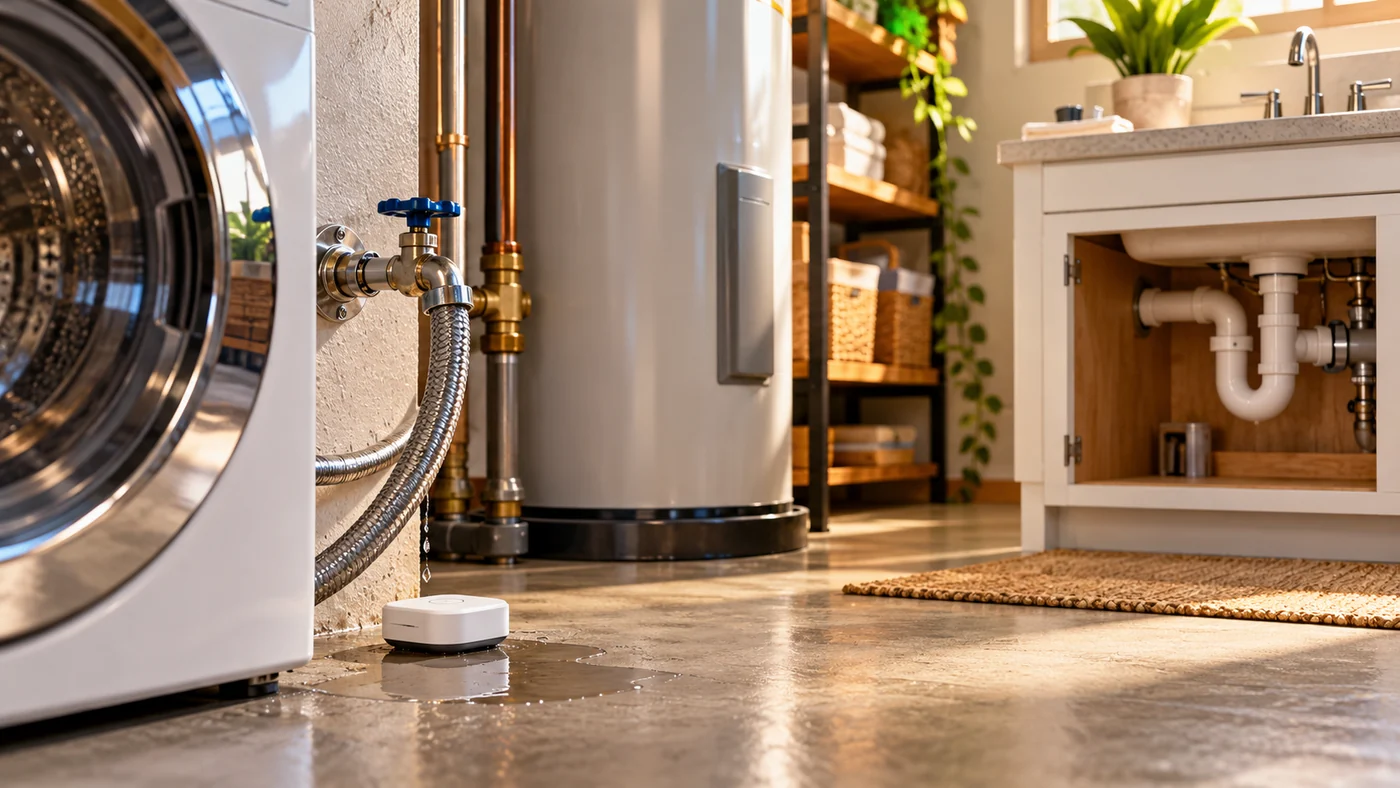
Leak detection is one of the simplest ways to add a layer of protection to a home’s plumbing. The right system depends on what you are trying to catch. A $20-class spot sensor can warn you when water reaches the floor under a sink. A whole-home smart water monitor can identify unusual flow even when the leak is hidden. A motorized shutoff valve can go one step further and stop the water automatically.
Why Home Water Leak Detection Matters
The U.S. Environmental Protection Agency says roughly 5% to 10% of U.S. homes have easy-to-fix leaks that waste 90 gallons of water per day or more. Leak detection does not repair those problems, but it can shorten the time between a leak starting and someone noticing it.
Potential benefits
- Earlier warning: catches water before a ceiling stain, warped floor or musty smell becomes the first clue.
- Damage mitigation: faster response can reduce the amount of water released.
- Protection while away: app alerts and automatic shutoff can help when no one is home.
- Water conservation: flow monitoring may expose running toilets, dripping fixtures or irrigation problems.
- Freeze awareness: some whole-home systems can warn about low temperatures or conditions associated with freezing pipes.
- Better plumbing visibility: usage histories can make unexplained changes easier to spot.
What leak detection cannot do
- It cannot prevent every pipe or appliance failure.
- A floor sensor cannot detect water that never reaches it.
- Whole-home monitors may need time to learn normal household use.
- Internet-dependent alerts can be limited by Wi-Fi or service outages.
- Automatic valves still need proper installation, testing and periodic maintenance.
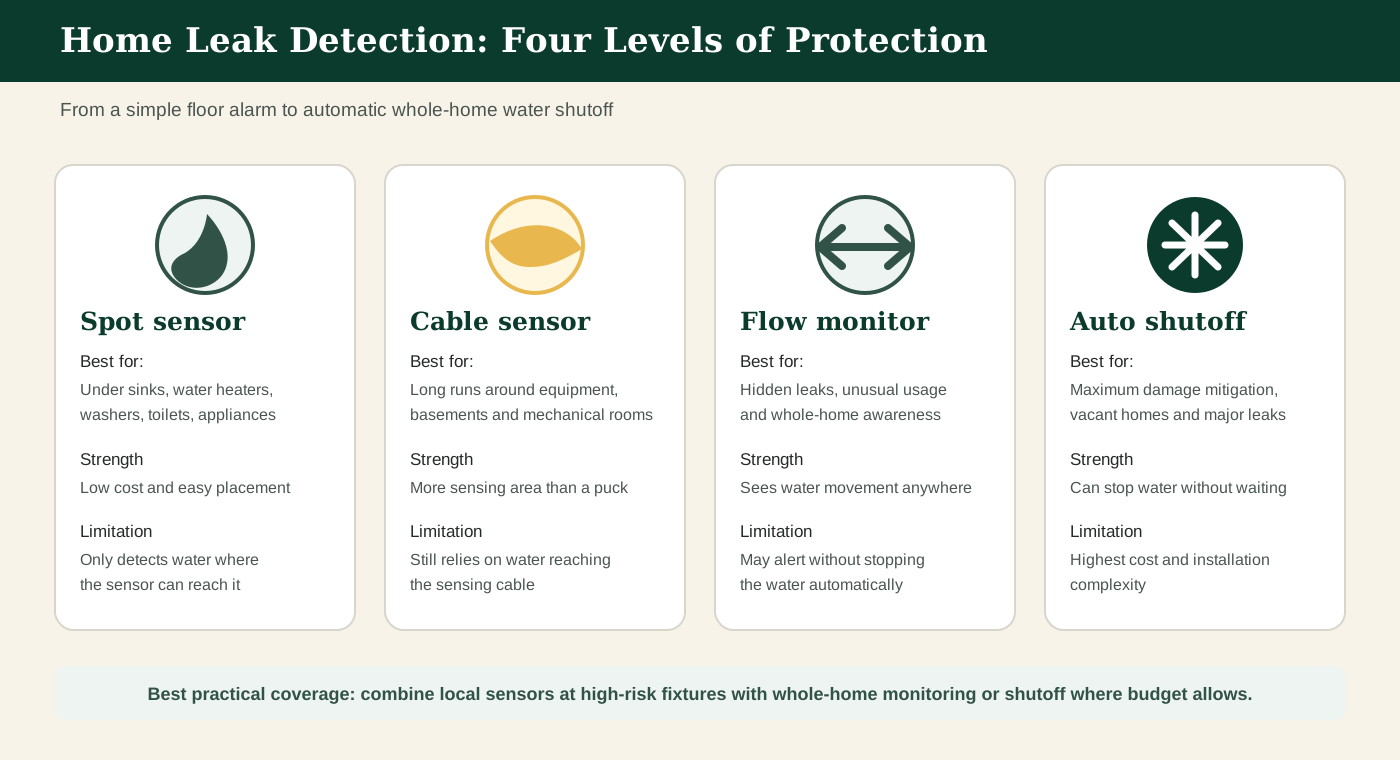
The Four Main Types of Home Leak Detection
| Type | How it works | Best use | Main limitation |
|---|---|---|---|
| Spot / puck sensor | Conductive contacts trigger when water bridges the sensor points. | Under sinks, behind toilets, near water heaters, washing machines, refrigerators and dishwashers. | Only detects water that physically reaches the sensor. |
| Rope / cable sensor | A sensing cable detects moisture along a longer path. | Mechanical rooms, long appliance runs, basement walls and equipment perimeters. | More expensive and still limited to where the cable is placed. |
| Whole-home flow monitor | Measures flow, pressure or usage patterns on the main water line and flags abnormal activity. | Hidden leaks, running fixtures and broad plumbing awareness. | May identify a problem without physically locating the leak. |
| Monitor + automatic shutoff | Combines flow analysis with a motorized valve that can close the main supply. | High-consequence leaks, vacation homes, second homes and maximum unattended protection. | Higher cost, more installation work and possible false shutoffs if settings are poorly tuned. |
Spot Sensors: The Low-Cost Starting Point
Spot sensors are small battery-powered devices placed where water should never be. When their contacts become wet, they sound an alarm and, on connected models, send a phone notification.
Where they work well
- Under kitchen and bathroom sinks
- Beside or behind toilets
- At the water heater pan
- Behind a washing machine
- Below refrigerator ice-maker lines
- Under dishwashers when accessible
- Near whole-house filters, softeners and RO systems
What to look for
Prioritize a loud local alarm, replaceable batteries, low-battery alerts and a simple way to test the sensor. Smart models should make notification settings easy to understand.
Protection Level at a Glance
The chart below is an editorial comparison of system categories for a typical home. It is not laboratory test data and does not rank specific brands.
Smart Alerts vs. Local Alarms
| Feature | Local alarm only | Connected smart sensor | Whole-home monitor / shutoff |
|---|---|---|---|
| Audible alarm in the house | Usually | Usually | Varies by product |
| Phone notification | No | Yes | Yes |
| Works when nobody is home | Only if someone can hear it | Yes, if network and service are available | Yes, if network and service are available |
| Detects hidden water use | No | No | Yes |
| Can automatically stop water | No | Only when paired with compatible valve automation | On shutoff-equipped models |
Where to Put Water Leak Sensors
Place a sensor in or immediately beside the drain pan without blocking the drain.
Position it where a hose, valve or drain leak would reach the floor first.
Put the sensor below supply stops, faucet connections, drain traps and garbage-disposal plumbing.
Place it near the supply line and tank connection, not where normal mopping will constantly trigger it.
Use a thin sensor or cable where it can detect supply-line leaks without being crushed.
If the toe-kick area permits, place a sensor where supply or drain leakage would emerge.
Softeners, filters and under-sink systems contain multiple fittings and are strong candidates for monitoring.
Cover floor drains, pumps, plumbing manifolds and any area where a leak could travel unseen.
Automatic Water Shutoff: When It Is Worth Considering
An automatic shutoff system adds an active response. Instead of only telling you something is wrong, the valve can close the main water supply when the system decides a leak is serious enough.
Strong use cases
- You travel frequently or spend long periods away from the property.
- The home has finished living space below kitchens, bathrooms or laundry areas.
- Plumbing failures would threaten expensive flooring, cabinetry, electronics or stored belongings.
- The house has older supply lines, complex plumbing or a history of leaks.
- You manage a second home or rental property and cannot respond immediately.
Situations that require extra planning
Fire-sprinkler systems, irrigation lines, well systems, recirculation loops and some treatment equipment can complicate installation or leak-learning algorithms. The valve must be located so it shuts off the intended domestic water without interfering with systems that require separate treatment.
What Generic Consumer Reviews Tend to Reveal
Review patterns across smart leak sensors and whole-home monitoring systems are useful for identifying ownership issues even when the devices differ. These themes should be treated as anecdotal experience, not controlled testing.
Fast alerts are the feature owners value most
People are happiest when a sensor catches a washing-machine hose drip, water-heater leak or under-sink problem before it spreads beyond the immediate area.
Setup quality matters more than people expect
Weak Wi-Fi, confusing hub pairing and missed permissions can turn a good sensor into an unreliable notification system. Owners who test alerts after setup tend to have fewer surprises.
Battery life is appreciated — until alerts are missed
Long battery life is convenient, but low-battery notifications and a regular replacement schedule matter because a forgotten sensor offers no protection.
False alarms are the main frustration
Condensation, cleaning water, unusual household usage or badly tuned thresholds can trigger nuisance alerts. Systems become more useful when sensitivity and household patterns are adjusted thoughtfully.
Automatic shutoff creates the most peace of mind
Owners who travel or have second homes often value the ability to stop water remotely or automatically more than detailed usage charts.
Installation cost can exceed expectations
Main-line systems may need a plumber, electrical outlet, adequate Wi-Fi and enough straight pipe or working space. The device price is only part of the project.
Connectivity, Hubs and Smart-Home Compatibility
Connected sensors generally use Wi-Fi, Zigbee, Z-Wave, Bluetooth-to-hub or proprietary long-range radio. None is universally best.
| Connection type | Advantages | Watch for |
|---|---|---|
| Direct Wi-Fi | No separate hub; easy phone access. | Battery use can be higher; distant basements may have weak coverage. |
| Zigbee / Z-Wave | Low-power sensors and mature smart-home automation. | Requires a compatible hub or controller. |
| Long-range proprietary radio | Useful for detached garages, basements and large properties. | Usually locks you into that manufacturer’s hub ecosystem. |
| Whole-home Wi-Fi monitor | Centralized flow data and remote control. | Cloud/app dependence varies; confirm what happens during internet or power outages. |
Trying to Find a Leak That May Already Be in the Wall?
If you are seeing stains, bubbling paint, soft drywall or unexplained water use, start with our How to Tell If a Water Leak Is Behind a Wall guide. It walks through the meter test, moisture checks and ways to narrow the source before opening drywall.
Installation: DIY Sensor or Plumber-Level Project?
DIY-friendly
Battery-powered floor sensors typically need little more than app pairing, placement and a test with a damp cloth. Cable sensors may require routing and clips but no plumbing modification.
Moderate DIY
Clamp-on or non-invasive monitors can be straightforward when the plumbing configuration matches the manufacturer’s requirements. Follow the exact pipe-size and placement instructions.
Professional installation often makes sense
Inline automatic shutoff valves require cutting into the main supply, maintaining correct flow direction, preserving serviceability and verifying that the valve can close completely. A licensed plumber is the safer choice when local code, access, pipe material or system complexity is uncertain.
Power Outages, Internet Outages and Failure Modes
A leak system should be evaluated by what it does when something goes wrong — not only when everything is connected.
- Local alarm: battery-powered sensors may still sound even if Wi-Fi is down.
- Remote notification: usually requires an internet path from the home to the service.
- Automatic shutoff: behavior during power loss varies. Some valves allow manual operation; some systems can use battery backup or retain limited local control.
- Cloud service: confirm whether core leak detection continues if an app service is unavailable.
- Stuck valves: exercise motorized shutoff valves periodically if the manufacturer recommends it.
Maintenance: A Leak Detector Is Not “Set It and Forget It”
| Task | Suggested habit | Why |
|---|---|---|
| Test each floor sensor | Every few months and after battery replacement | Confirms the alarm, app and automation still work. |
| Review battery status | At least seasonally | Prevents silent failure from a dead battery. |
| Check app notifications | After phone changes, router changes or app updates | Permissions can be lost or modified. |
| Inspect hoses and fittings | During routine home maintenance | Detection is a backup, not a substitute for replacing deteriorated parts. |
| Exercise automatic valve | Per manufacturer instructions | Confirms the motorized shutoff can move when needed. |
| Review alert history | After unusual water use | Helps distinguish real leaks from recurring false alarms. |
How to Choose a Home Leak Detection System
| Question | Why it matters |
|---|---|
| Do I only need to protect a few fixtures? | Local sensors may provide excellent value without modifying plumbing. |
| Do I want alerts while away? | Choose a connected sensor and test push notifications before relying on it. |
| Do I need to detect hidden leaks? | Consider main-line flow monitoring in addition to floor sensors. |
| Do I want the water shut off automatically? | Look for an integrated motorized valve or a tested sensor-to-valve automation. |
| Will Wi-Fi reach the sensor locations? | Basements, utility rooms and detached garages often have weak signal. |
| Is there a subscription? | Some features may be included while advanced monitoring or support can be optional or paid. |
| What happens if power or internet fails? | Failure behavior determines whether protection continues locally. |
| Can I test and maintain it easily? | A device you never test can create false confidence. |
Leak Detection and Home Insurance
Some insurers offer discounts or incentives for professionally installed leak detection or automatic shutoff systems, but eligibility varies by carrier, state, device and policy. A manufacturer’s statement that discounts may be available is not a guarantee that your insurer will provide one.
Before buying a system for an insurance discount, ask your insurer which devices qualify, whether professional installation is required, and what documentation must be submitted.
A Practical Layered Protection Plan
For many homes, a sensible leak-detection strategy looks like this:
- Place connected spot sensors at the water heater, washing machine, kitchen sink, main bathroom sinks and other high-risk fixtures.
- Add rope or cable sensing where a single puck would leave large areas uncovered.
- Use a whole-home flow monitor if you want visibility into hidden leaks and unusual usage.
- Add automatic main-water shutoff when unattended damage is the biggest concern.
- Test every alert and shutoff path before treating the system as protection.
This approach avoids the false choice between inexpensive floor sensors and a more sophisticated whole-home system. They solve different problems and work well together.
The Bottom Line
The best home leak detection system is the one that notices the kinds of leaks your house is most likely to experience and gives you enough time to act. Small floor sensors are inexpensive and useful. Whole-home monitoring adds visibility. Automatic shutoff adds the strongest response when nobody is available to turn off the water.
For most homeowners, start with sensors at the highest-risk fixtures and build from there.
Before You Buy
- Map your highest-risk plumbing locations.
- Decide whether you need local alarms, phone alerts or automatic shutoff.
- Confirm Wi-Fi or hub coverage.
- Check battery and power-failure behavior.
- Ask about subscriptions and app requirements.
- Verify pipe size and installation requirements for main-line systems.
- Test the system after installation and on a regular schedule.
Related Home Improvement Guide
Research Sources & Methodology
This article uses public information from the U.S. Environmental Protection Agency and current manufacturer documentation to explain the technology, along with broad ownership themes commonly reported for connected leak sensors and whole-home monitoring systems. Product features change over time; confirm current specifications with the manufacturer before purchasing or installing a device.
- U.S. EPA WaterSense — household water-use and leak facts
- Moen — Flo Smart Water Monitor and Shutoff features
- Phyn — Smart Water Assistant features and leak alerts
- Phyn — whole-home leak monitoring, freeze alerts and insurance-discount information
- Aqara — Water Leak Sensor specifications and automation examples
Editorial note: Review themes in this article are intentionally generic and are not presented as scores or rankings of individual products. Manufacturer performance claims should be read in the context of the manufacturer’s own testing and current product documentation.