
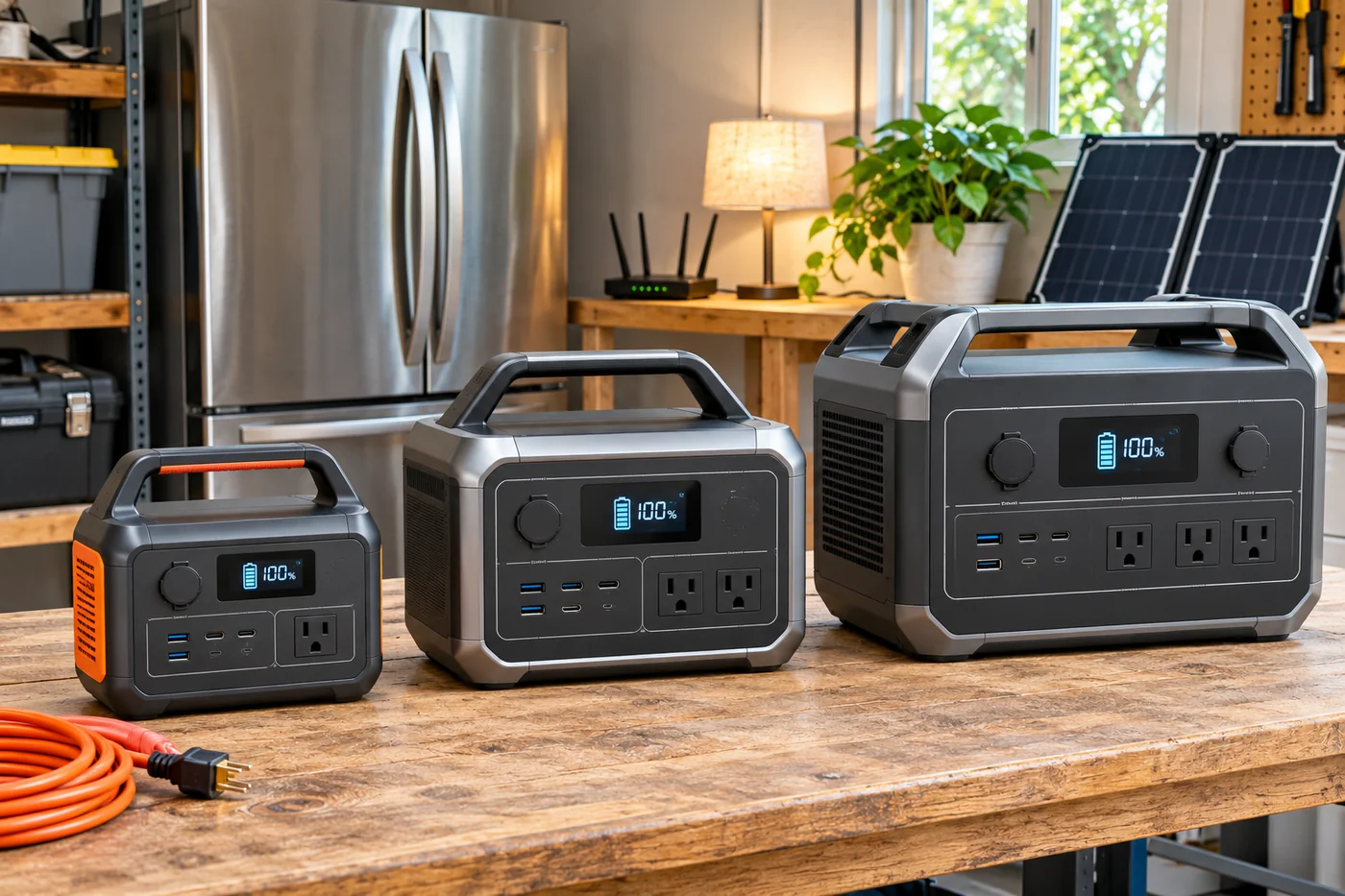
The best portable power station for home backup is usually not the largest unit you can afford. It is the one that gives you enough battery capacity and inverter output for your essential loads while still being practical to move, recharge and store.
Best Portable Power Stations for Home Backup: Quick Comparison
| Model | Capacity | AC Output | Weight | Solar Input | Best For |
|---|---|---|---|---|---|
| BLUETTI AC200L | 2,048Wh | 2,400W | 62.4 lb | 1,200W | Best overall balance |
| Jackery Explorer 2000 v2 | 2,042Wh | 2,200W | 39.5 lb | 400W | Best for portability |
| Anker SOLIX F2000 | 2,048Wh | 2,400W | 67.2 lb | 1,000W | Strong 2kWh solar option |
| BLUETTI Elite 200 V2 | 2,073.6Wh | 2,600W | 53.4 lb | 1,000W | Compact high-output 2kWh option |
| BLUETTI Apex 300 | 2,764.8Wh | 3,840W | 83.8 lb | 2,400W | Best for larger backup loads |
How We Chose These Portable Power Stations
For home backup, we give more weight to practical electrical capability than to camping features. The most important factors are:
- Battery capacity: how much energy you can store.
- Continuous AC output: how many appliances can run at once.
- Surge capability: whether refrigerators and other motor loads can start reliably.
- Weight and portability: whether one person can realistically move the unit.
- Recharge speed: how quickly the battery can recover from a partial or full discharge.
- Solar input: especially important for multi-day outages.
- Expandability: whether you can add more battery capacity later.
1. BLUETTI AC200L — Best Overall Balance
The BLUETTI AC200L is the most balanced model in this group for general home backup. It combines a 2,048Wh LiFePO₄ battery with 2,400W of continuous output, 3,600W surge capability and up to 1,200W of solar input.
That gives it enough inverter headroom for a refrigerator, router, lights and selected kitchen appliances without immediately moving into the much heavier 3–5kWh class. It also recharges quickly from AC and can accept compatible expansion batteries.
Why it stands out
- 2,048Wh LiFePO₄ battery
- 2,400W continuous output
- 1,200W solar input
- Expandable battery options
- Good match for essential household loads
Keep in mind
- 62.4 lb is movable but not light
- Not a substitute for unrestricted whole-home backup
- High-wattage heating loads can drain it quickly
2. Jackery Explorer 2000 v2 — Best for Portability
The Jackery Explorer 2000 v2 is the standout if weight matters. Jackery lists 2,042Wh of LiFePO₄ capacity and 2,200W of continuous AC output in a unit weighing about 39.5 lb.
That is a major advantage if you expect to move the power station between a garage, kitchen, RV or another property. It also supports a 4,400W surge peak, giving it useful compressor-starting margin for refrigerators and similar appliances.
The main tradeoff is solar input. With a 400W maximum solar input, it is slower to replenish from panels than several heavier competitors. For shorter outages or users who expect to recharge mainly from a wall outlet, that may not matter.
3. Anker SOLIX F2000 — Strong 2kWh Solar Option
The Anker SOLIX F2000 provides 2,048Wh of battery capacity, 2,400W of AC output and up to 1,000W of solar input. That makes it a solid choice for someone who wants 2kWh-class storage but places more emphasis on solar recharging.
At 67.2 lb it is heavier than the Jackery and slightly heavier than the BLUETTI AC200L, so it is better thought of as a movable home-backup unit than something you will casually carry around.
4. BLUETTI Elite 200 V2 — Compact High-Output 2kWh Option
The BLUETTI Elite 200 V2 fits neatly into the same 2kWh portable class with 2,073.6Wh of LiFePO₄ capacity, 2,600W of continuous AC output and up to 1,000W of solar input.
At about 53.4 lb, it lands between the lighter Jackery and the heavier AC200L/F2000 class. The extra 200W of continuous output also gives it a little more inverter headroom than most 2,400W competitors in this size range.
Unlike the AC200L and Apex 300, the Elite 200 V2 is not expandable, so it makes the most sense for buyers who want a self-contained 2kWh-class unit rather than a system they plan to grow later.
5. BLUETTI Apex 300 — Best for Larger Backup Loads
The BLUETTI Apex 300 is much closer to a modular home-backup system than a grab-and-go power station. Its 2,764.8Wh LiFePO₄ battery and 3,840W of continuous output give it substantially more electrical headroom than the 2kWh units.
It also accepts up to 2,400W of solar input and can scale with multiple compatible expansion batteries. The tradeoff is obvious: at about 83.8 lb, this is portable in the sense that it can be moved, not something most people will want to carry frequently.
What Size Portable Power Station Is Best for Home Backup?
| Capacity Class | Typical Use | Who It Fits |
|---|---|---|
| 500–1,000Wh | Router, phones, lights, short refrigerator support | Short outages and minimal loads |
| 1,000–2,000Wh | Refrigerator, router, electronics, some overnight backup | Basic home essentials |
| 2,000–3,000Wh | Refrigerator, freezer, internet, lights and more appliance flexibility | Best overall range for many homes |
| 3,000–5,000Wh+ | Multiple larger loads and longer runtime | Extended outages or larger partial-home backup |
If you are not sure where to start, our Home Backup Power Beginner’s Guide explains watts, watt-hours and runtime in more detail.
How Much Does Weight Matter?
Quite a lot. A portable power station that weighs 80 lb may be technically movable, but it is very different from a 40 lb unit you can lift into a vehicle without much trouble.
If the unit will live beside your electrical panel or refrigerator most of the time, weight matters less. If you expect to carry it between rooms, take it on trips or move it frequently during an outage, the lighter Jackery-class units have a real practical advantage.
Recharge Speed Matters More Than Many Buyers Expect
Battery size tells you how long the system can run. Recharge speed tells you how quickly you can get that runtime back.
For a one-night outage, almost any properly sized 2kWh power station can be useful. During a multi-day outage, a system that can accept 1,000–2,400W of solar or recharge quickly from AC or a generator becomes much more valuable than a similar-capacity unit with slow input.
This is also why the “best” portable power station is not always the lightest one.
Portable Power Station vs. Solar Generator
These terms overlap. A portable power station is the battery-and-inverter unit itself. When you pair it with solar panels, it is commonly marketed as a solar generator.
If solar charging is central to your plan, see our Best Solar Generators for Home Backup Power comparison. That article gives more weight to panel input and multi-day solar replenishment.
Can a Portable Power Station Run a Refrigerator?
Yes, as long as the inverter can handle the refrigerator’s compressor startup surge and the battery has enough capacity for the runtime you need.
For a detailed sizing walkthrough, see What Size Generator or Battery Backup Do You Need for a Refrigerator?.
Choose a Lighter Unit If
- You need to move it often
- Outages are usually short
- You mainly power a refrigerator and electronics
- You recharge mostly from AC
- Storage space is limited
Choose a Larger Expandable Unit If
- You expect multi-day outages
- You want to add batteries later
- You need larger simultaneous loads
- Solar recharging is important
- The unit can remain mostly stationary
Which Portable Power Station Would We Choose?
For a typical household, the BLUETTI AC200L is the best overall balance in this group. It has enough output for common home-backup loads, strong solar input for its size and the ability to expand later.
If carrying weight matters most, the Jackery Explorer 2000 v2 is the easiest 2kWh-class unit here to move. If solar recharging is a priority, the Anker SOLIX F2000 and BLUETTI Elite 200 V2 both offer 1,000W solar-input ceilings. For larger loads and future expansion, the BLUETTI Apex 300 provides the most headroom.
Home Backup Power Series
- Home Backup Power: A Beginner’s Guide to Batteries, Solar and Generators
- Best Solar Generators for Home Backup Power
- What Size Generator or Battery Backup Do You Need for a Refrigerator?
- Best Portable Power Stations for Home Backup — you are here
Bottom Line
For many households, a 2,000–3,000Wh LiFePO₄ portable power station is the best compromise between runtime, output, price and portability. That size can cover a refrigerator, internet, lights and selected appliances without forcing you into a much larger installed battery system.
Think beyond battery size
When comparing models, pay just as much attention to weight, inverter output and recharge speed. Those three specifications often determine whether a power station is convenient during an outage or simply impressive on paper.
Research Sources & Methodology
Specifications were checked against current manufacturer information. Product configurations and ratings can change, so verify current specifications before purchasing.