
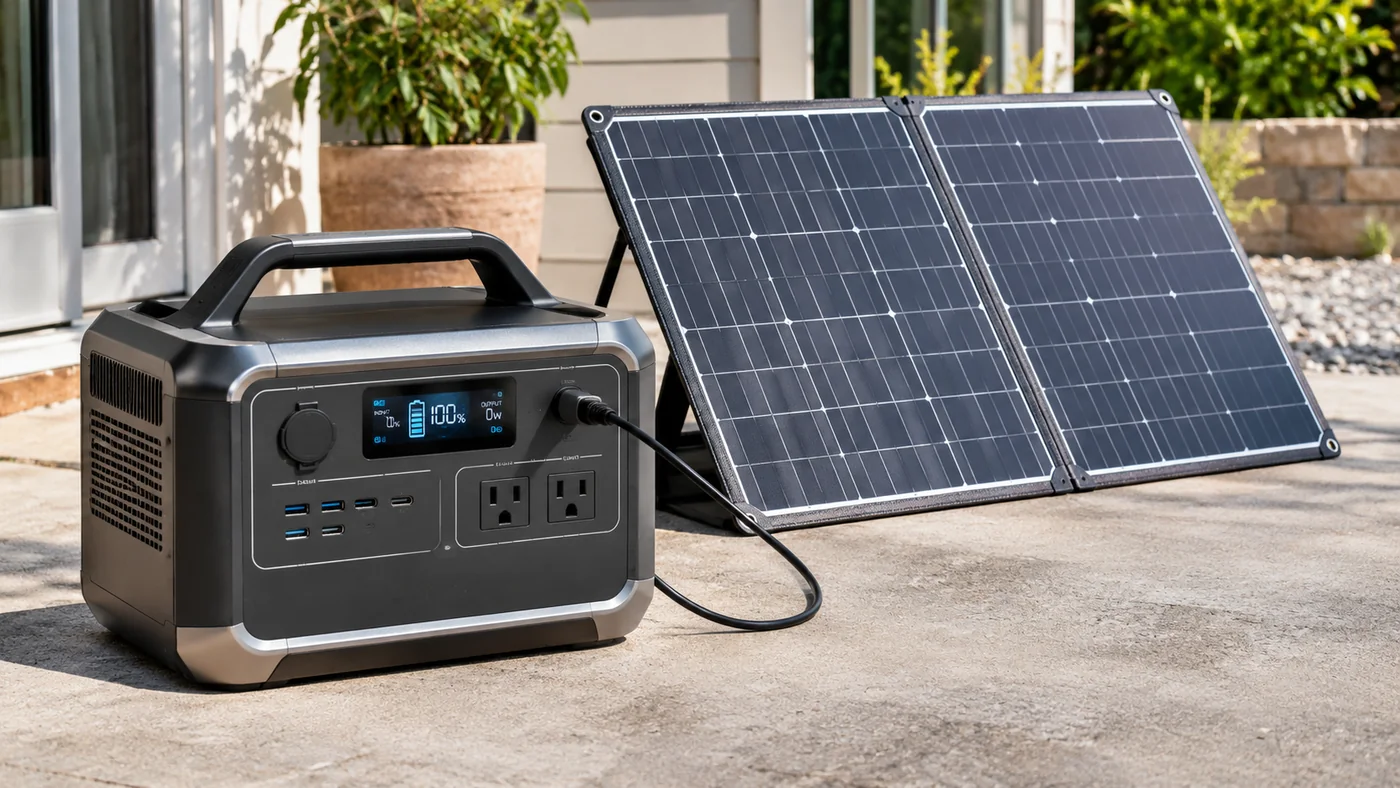
The best solar generator for home backup is not automatically the biggest one. If you are searching for the best solar generator for home backup power, focus first on usable battery capacity, inverter output and solar recharge rate. The right system needs enough inverter output to start your essential appliances, enough battery capacity to keep them running, and enough solar input to replace meaningful energy during a longer outage.
Before You Compare Models
If you are new to backup power, start with our Home Backup Power Beginner’s Guide. It explains watts, watt-hours, runtime, solar charging and the difference between battery systems and fuel generators. This article picks up from there and focuses on specific solar-generator systems.
Best Solar Generators for Home Backup Power: Quick Comparison
| Model | Battery | Continuous AC Output | Max Solar Input | Best For |
|---|---|---|---|---|
| Bluetti AC200L | 2,048Wh | 2,400W | 1,200W | Best balance for most households |
| Bluetti Apex 300 | 2,764.8Wh | 3,840W | Up to 2,400W DC input | Expandable higher-output backup |
| BLUETTI AC500 + B300K | 2,764.8Wh | 5,000W | 3,000W | High-output expandable home backup |
| Jackery Explorer 2000 v2 | 2,042Wh | 2,200W | 400W | Lighter 2kWh-class backup |
| Anker SOLIX F2000 | 2,048Wh | 2,400W | 1,000W | Strong solar input in a 2kWh system |
What We Look For in a Home Backup Solar Generator
A “solar generator” is really a portable battery power station that can recharge from solar panels. For home backup, five specifications matter most:
- Battery capacity: Watt-hours determine how long your loads can run.
- Continuous inverter output: This determines how much equipment you can power at once.
- Surge capability: Refrigerators, pumps and other motor-driven appliances can need extra power at startup.
- Solar input: A large battery is much more useful during a multi-day outage if your panels can replace a meaningful amount of energy each day.
- Expandability: Extra batteries can turn a portable system into a larger home-backup setup later.
1. Bluetti AC200L — Best Balance for Most Households
The Bluetti AC200L is a strong middle-ground option because its 2,048Wh LiFePO₄ battery is paired with a 2,400W pure-sine-wave inverter and up to 1,200W of solar input.
For a typical outage plan—refrigerator, internet equipment, lights, phones, television and occasional use of a small kitchen appliance—the AC200L offers a practical combination of battery size and output. It can also accept compatible expansion batteries if you later want more runtime.
Why it stands out
- 2,048Wh LiFePO₄ capacity
- 2,400W continuous AC output
- 1,200W maximum solar input
- Expandable battery options
- Good fit for essential household loads
Keep in mind
- About 62 lb, so it is portable but not lightweight
- 2kWh is not unrestricted whole-home backup
- High-wattage heating and cooling loads can drain it quickly
2. Bluetti Apex 300 — Best Expandable Higher-Output Option
The Bluetti Apex 300 moves into a more serious home-backup class with 2,764.8Wh of base capacity and 3,840W of continuous AC output. Its two DC input ports can accept up to 1,200W each.
The bigger reason to consider the Apex 300 is expandability. Bluetti supports compatible B300K and B500K expansion batteries, so you can start with the base power station and grow the system if you later decide you want longer outage coverage.
Why it stands out
- 2,764.8Wh base capacity
- 3,840W continuous output
- High solar-input potential
- Substantial expansion capability
- Better suited to larger simultaneous loads
Keep in mind
- Heavier and more expensive than 2kWh-class systems
- Expansion batteries add cost and storage space
- Home integration can require additional equipment
3. BLUETTI AC500 + B300K — Best High-Output Expandable Option
The BLUETTI AC500 paired with one B300K battery starts at 2,764.8Wh of storage and delivers up to 5,000W of AC output. BLUETTI also lists up to 3,000W of solar input, giving this modular system considerably more charging headroom than many smaller portable power stations.
The AC500 is especially useful if your backup plan is likely to grow. With additional B300K batteries, the system can expand well beyond its starting capacity. For 240V split-phase applications, BLUETTI uses a two-AC500 configuration, so shoppers considering larger home circuits should factor that additional equipment into the total system cost.
4. Jackery Explorer 2000 v2 — Best Lighter 2kWh-Class Option
The Jackery Explorer 2000 v2 has a 2,042Wh LiFePO₄ battery and 2,200W total AC output while weighing about 39.5 lb. That makes it noticeably easier to move than several other 2kWh-class systems.
The compromise is solar input: Jackery lists a maximum of 400W for this model. That can be fine for topping off a lightly used battery, but it is a more important limitation if your goal is to replace a large amount of energy from solar every day during an extended outage.
5. Anker SOLIX F2000 — Best Solar Input in a 2kWh-Class System
The Anker SOLIX F2000 combines a 2,048Wh battery, 2,400W AC output and up to 1,000W of solar input. That makes it a useful comparison for shoppers who want roughly 2kWh of stored energy but care more about solar recharge speed than minimal weight.
At about 67 lb, the F2000 is not particularly light, but its larger solar-input ceiling makes more sense for multi-day backup than a 2kWh power station limited to only a few hundred watts of solar.
How Much Solar Do You Actually Need?
The panel wattage on the box is not what you will collect all day. Clouds, panel angle, temperature, shading and the sun’s position all reduce real-world production. A better planning method is to think in daily watt-hours.
Panel watts × strong equivalent sun-hours × system efficiency ≈ daily watt-hours harvested.
For example, a 600W solar array receiving roughly five strong equivalent sun-hours could theoretically produce about 3,000Wh before system losses. Real production will usually be lower. If your essential loads consume about 2,000Wh per day, that can be meaningful. If you are consuming 6,000Wh per day, it will not keep up.
How Big a Battery Should You Buy?
| Battery Size | Best Fit | What to Expect |
|---|---|---|
| 1–2 kWh | Basic essentials | Refrigerator, router, lights, phones and modest electronics for limited periods |
| 2–4 kWh | Stronger home backup | Essentials plus more appliance flexibility and longer refrigerator runtime |
| 4–8 kWh | Extended outage coverage | Multiple essential loads with a better overnight reserve |
| 8 kWh+ | Larger partial-home systems | Better suited to multi-day backup, especially with substantial solar input |
Those are planning ranges, not guarantees. Actual runtime depends on appliance draw, inverter losses, temperature and how often motor-driven appliances cycle on and off.
Can a Solar Generator Run a Refrigerator?
Yes. Many 2kWh-class solar generators can run a modern refrigerator, but startup surge and actual daily energy use matter. A refrigerator that averages modest power over a full day can still draw several times its normal running wattage for a short period when the compressor starts.
We are covering this in detail in the next article in this series: What Size Generator or Battery Backup Do You Need for a Refrigerator?
Solar Generator Advantages
- Quiet operation
- No combustion exhaust at the point of use
- Can be used indoors
- Instant power for electronics and appliances
- Solar can extend runtime during longer outages
Where a Fuel Generator Still Wins
- Very high loads for long periods
- Fast refueling when fuel is available
- Often lower initial cost per watt of output
- Useful when solar conditions are poor for several days
Which One Would We Choose?
For a typical household focused on essential backup, the Bluetti AC200L is the most balanced starting point in this group because its 2,048Wh battery, 2,400W output and 1,200W solar-input ceiling are well matched.
If the goal is a system that can grow substantially over time, the Bluetti Apex 300 or BLUETTI AC500 + B300K gives you more headroom. If portability matters more than solar-recharge speed, the Jackery Explorer 2000 v2 is considerably lighter. If you want a 2kWh-class battery with relatively strong solar input, the Anker SOLIX F2000 is worth comparing.
Home Backup Power Series
- Home Backup Power: A Beginner’s Guide to Batteries, Solar and Generators
- Best Solar Generators for Home Backup Power — you are here
- What Size Generator or Battery Backup Do You Need for a Refrigerator?
- Best Portable Power Stations for Home Backup
Bottom Line
The best solar generator for home backup is the one that matches three numbers: the watts your appliances need at the same time, the watt-hours you use in a day, and the amount of solar energy you can realistically replace. For many households, a 2–4 kWh LiFePO₄ system with at least 2,000W of inverter output is a practical starting point.
What matters most
If you expect multi-day outages, give solar-input capacity and expandability nearly as much weight as battery size. A large battery that recharges too slowly can be less useful than a slightly smaller system with much stronger solar input.
Research Sources & Methodology
Product specifications were checked against current manufacturer information. Ratings and configurations can change, so confirm current specifications before buying.