
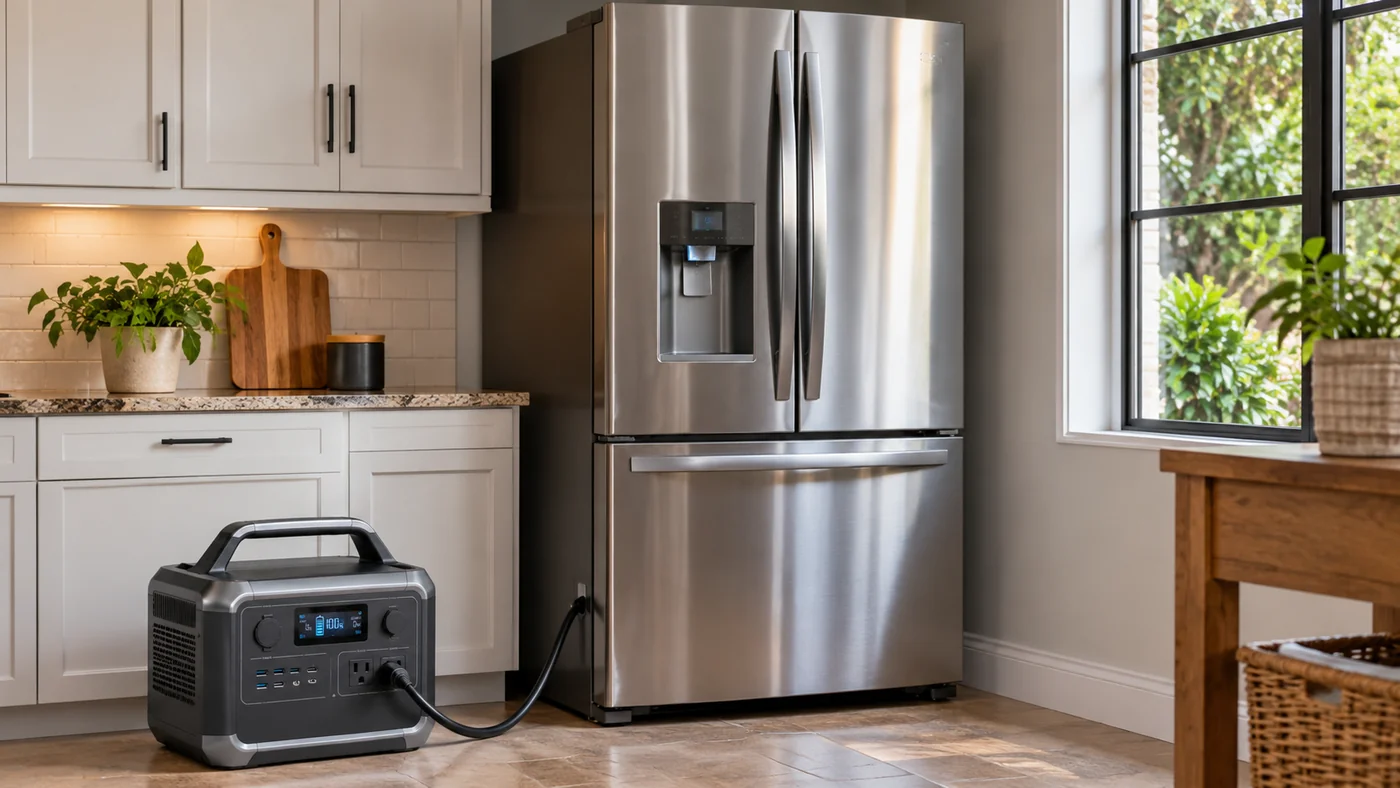
For most modern refrigerators, backup power for refrigerator use starts with a backup power source with at least 1,000–1,500W of inverter output and roughly 1,000–2,000Wh of battery capacity is a practical starting point. But that is only a starting point. The refrigerator’s compressor startup surge, daily energy use, age and whether you are also powering a freezer can change the answer considerably.
Why Refrigerator Backup Power Is Harder to Size Than It Looks
A refrigerator does not draw the same amount of power all day. The compressor cycles on and off, defrost heaters may operate periodically, and startup can require far more power than steady running.
A U.S. Department of Energy-hosted refrigeration study illustrates the issue well: one conventional refrigerator ran at roughly 140W once the compressor was operating, but startup briefly reached around 1,000W. That is why sizing only from the refrigerator’s normal running watts can lead to a backup system that shuts down when the compressor starts.
The safest approach is to check the refrigerator’s nameplate, owner’s manual or measured wattage and then give yourself extra surge margin.
Running Watts vs. Startup Watts
Running watts
This is the power the refrigerator uses while the compressor is already operating. Many household refrigerators spend much of the day below their maximum rated wattage because the compressor cycles.
Startup or surge watts
This is the short burst of power needed when the compressor starts. Your inverter or generator must handle this brief surge even if the refrigerator’s normal running load is much lower.
For generator or battery-backup sizing, the surge rating determines whether the refrigerator will start; battery capacity determines how long it will keep running.
What Size Battery Backup Do You Need for a Refrigerator?
| Battery Size | Practical Use | What to Expect |
|---|---|---|
| 500–750Wh | Short outages | Useful for several hours with an efficient refrigerator, but little reserve for other loads |
| 1,000Wh | Basic refrigerator backup | A practical minimum for many homes if the inverter can handle compressor surge |
| 2,000Wh | Refrigerator + essentials | Much more comfortable for overnight backup, router, lights and phone charging |
| 3,000Wh+ | Longer outages or multiple cold-storage loads | Better for a refrigerator plus freezer or households that want a larger energy reserve |
These are planning ranges, not guarantees. Refrigerator efficiency varies widely. ENERGY STAR notes that larger refrigerators generally use more energy and that the most efficient conventional sizes are often around 16–20 cubic feet.
How Long Will a Battery Run a Refrigerator?
You can estimate runtime with a simple formula:
For planning, using about 85% of the battery’s advertised capacity gives some allowance for inverter losses and reserve.
| Battery | Approx. Usable Energy at 85% | At 100W Average Load | At 150W Average Load |
|---|---|---|---|
| 1,000Wh | 850Wh | About 8.5 hours | About 5.7 hours |
| 2,000Wh | 1,700Wh | About 17 hours | About 11.3 hours |
| 3,000Wh | 2,550Wh | About 25.5 hours | About 17 hours |
| 4,000Wh | 3,400Wh | About 34 hours | About 22.7 hours |
Real refrigerators cycle, so the average load over many hours matters more than the instantaneous running wattage. Opening the door frequently, hot food, warm room temperatures and defrost cycles can all reduce runtime.
Example: A 2,048Wh Power Station
A system such as the BLUETTI AC200L has 2,048Wh of battery capacity and 2,400W of continuous AC output. Using an 85% planning allowance leaves roughly 1,740Wh of usable energy.
If a refrigerator averages about 100W over time, that works out to roughly 17 hours before allowing for other loads. At a 150W average, it is closer to 11–12 hours. In practice, the refrigerator’s duty cycle may extend or shorten those figures.
The AC200L’s inverter output also gives substantially more compressor-starting headroom than a very small battery pack designed mainly for electronics.
What Size Portable Generator Do You Need for a Refrigerator?
If you are using a fuel generator instead of a battery power station, the same surge rule applies. A small generator may show enough running watts on paper but still struggle with compressor startup if there is little headroom.
For one refrigerator, a portable generator in roughly the 1,500–2,000 running-watt class generally gives useful margin for startup and a few small additional loads. If you also want to run a freezer, lights, router or another appliance at the same time, moving to the 2,500–3,500W class gives you much more flexibility.
Do not run a gasoline, propane or dual-fuel portable generator indoors, in a garage or near openings. Fuel generators must remain outside and well away from windows, doors and vents because of carbon-monoxide risk.
Refrigerator + Freezer: Size Them Together
A refrigerator and a chest or upright freezer may each have modest running loads, but the worst-case situation is both compressors trying to start at nearly the same time.
For battery backup, a 2,000Wh-class system with a strong inverter is a much better starting point than a 1,000Wh unit if you want to protect both appliances. For a fuel generator, give yourself enough continuous wattage for both running loads plus generous surge capacity.
What About a Refrigerator and Wi-Fi Router?
This is one of the easiest useful backup combinations. A Wi-Fi router typically adds only a modest continuous load compared with a refrigerator, so a properly sized 1–2kWh battery power station can often keep both running for a meaningful period.
If your outage plan is simply refrigerator + router + a few LED lights + phone charging, you generally do not need a giant whole-home battery system. A well-sized portable power station can cover those essentials efficiently and quietly.
Battery Backup Makes Sense When
- You want quiet indoor operation
- You mainly need refrigerator, internet and electronics
- You expect shorter outages
- You want solar charging as an option
- You do not want to store fuel
A Fuel Generator Makes Sense When
- Outages may last for days
- You need several large appliances
- You have access to stored fuel
- You need more sustained output than a battery can economically provide
- Solar conditions may be poor
How to Size Your Refrigerator Backup Correctly
- Find the refrigerator’s rated watts or amps. Check the label inside the refrigerator, on the back, or in the manual.
- Allow for compressor startup. Do not choose an inverter whose maximum output is barely above the running load.
- Estimate daily energy use. The EnergyGuide label can help with annual kWh consumption.
- Decide how many hours you need. A six-hour outage and a 24-hour outage require very different battery sizes.
- Add every other load. Include freezer, router, lights, CPAP, phones or other essentials.
- Leave reserve capacity. Avoid designing the system to operate right at its maximum limits.
Best Backup Power for a Refrigerator: Battery or Generator?
For a refrigerator alone or a refrigerator plus a few electronics, a battery power station is usually the easier solution: quiet, instant, indoor-safe and low-maintenance. For longer outages or multiple large appliances, a portable fuel generator gives you more sustained energy as long as fuel is available.
For many households, the strongest approach is a hybrid: run the refrigerator from a battery power station most of the time, then recharge that battery from solar or a fuel generator during an extended outage.
Home Backup Power Series
- Home Backup Power: A Beginner’s Guide to Batteries, Solar and Generators
- Best Solar Generators for Home Backup Power
- What Size Generator or Battery Backup Do You Need for a Refrigerator? — you are here
- Best Portable Power Stations for Home Backup
Bottom Line
For a single refrigerator, a pure-sine-wave battery power station with roughly 1,000–2,000Wh of capacity and enough inverter surge capability to start the compressor is a practical target. If you are also backing up a freezer or want overnight reserve for other household essentials, the 2,000Wh class is the safer place to start.
Do not overlook startup surge
A refrigerator that runs on relatively little power can still demand a large burst of power for a fraction of a second when its compressor starts. That single detail is why undersized generators and small battery packs sometimes fail even though their advertised wattage seems adequate.
Research Sources & Methodology
Planning ranges are intended as practical guidance. Always verify your refrigerator’s actual electrical requirements before purchasing backup equipment.