
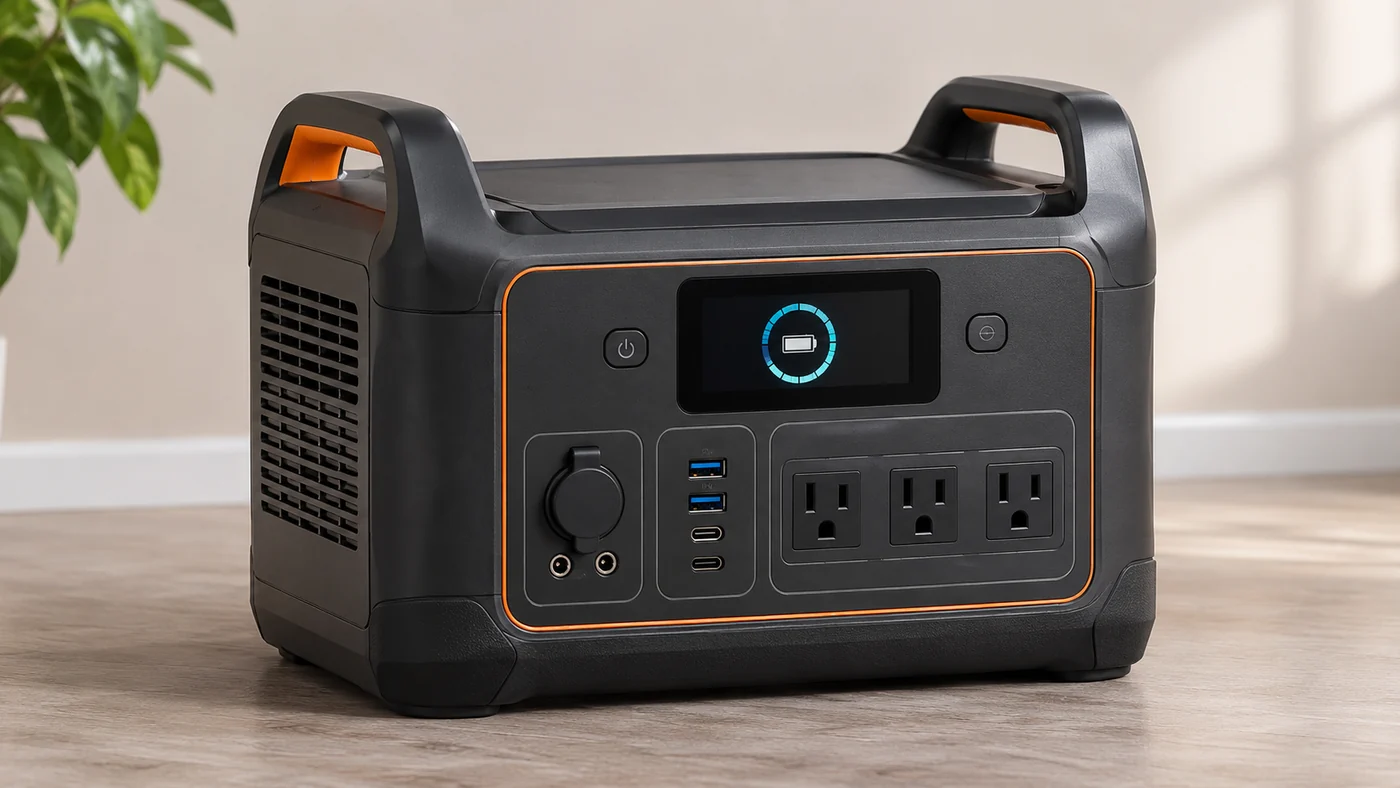
Home backup power has become a much broader category than “buy a generator.” You can now choose from portable gasoline or propane generators, rechargeable battery power stations, expandable home batteries and systems that can recharge from solar panels. The confusing part is that manufacturers often advertise big watt numbers without explaining how those numbers translate into a refrigerator, lights, internet equipment or a microwave during an outage.
The Three Main Ways to Back Up Power at Home
| Type | What it does well | Main limitation | Best fit |
|---|---|---|---|
| Battery power station | Quiet, indoor-friendly operation; instant power; easy charging from a wall outlet | Stored energy eventually runs out | Refrigerator, Wi-Fi, lights, electronics, medical devices and short outages |
| Battery + solar | Same battery system, but solar can extend runtime during a long outage | Solar output changes with weather, panel size and sun angle | Multi-day outages, off-grid use and users who want renewable recharging |
| Fuel generator | High continuous output and fast “refueling” as long as fuel is available | Noise, maintenance, exhaust and carbon-monoxide risk | Heavy loads, long outages and situations where fuel storage is practical |
A “solar generator” is usually not a generator in the traditional engine-driven sense. It is normally a battery, inverter and charge controller packaged together, with solar panels as one charging option. Most of these units can also recharge from a wall outlet, and many can charge from a vehicle.
Watts: How Much Power Can You Use Right Now?
Watts (W) describe the rate at which an appliance uses power. If a microwave draws 1,200 watts and your power station can only deliver 1,000 watts continuously, the battery may have plenty of stored energy but still be unable to run the microwave.
For sizing, pay attention to two ratings:
- Continuous output: what the inverter can supply steadily.
- Surge or startup output: the short burst needed when compressors and motors start.
Refrigerators, freezers, pumps and some power tools can draw several times their normal running load for a moment at startup.
Watt-Hours: How Long Can You Run It?
Watt-hours (Wh) describe stored energy. A 2,000Wh battery theoretically contains enough energy to supply 200 watts for 10 hours. Real systems lose some energy in the inverter and electronics, so it is better to plan with a reserve.
Rated battery Wh × 0.85 ÷ average appliance watts ≈ estimated runtime in hours.
The 0.85 factor is only a planning estimate. Actual efficiency changes with load, temperature, battery condition and the equipment itself.
How Far Do 1,000Wh, 2,000Wh and 4,000Wh Go?
The easiest way to understand battery size is to think in terms of a small group of essential loads. The examples below use an 85% usable-energy assumption and are deliberately rounded.
| Rated capacity | Approx. usable energy | 150W average load | 300W average load | What it feels like in practice |
|---|---|---|---|---|
| 1,000Wh | ~850Wh | ~5.7 hours | ~2.8 hours | Short essential-device coverage |
| 2,000Wh | ~1,700Wh | ~11.3 hours | ~5.7 hours | Useful refrigerator + electronics class |
| 4,000Wh | ~3,400Wh | ~22.7 hours | ~11.3 hours | Longer essential-load coverage or more appliances |
| 8,000Wh | ~6,800Wh | ~45 hours | ~22.7 hours | Extended backup with disciplined load management |
Those numbers are not promises. A refrigerator cycles on and off rather than pulling its running wattage continuously, while a microwave may draw a large load for only a few minutes. The best estimate comes from measuring or looking up the actual devices you plan to use.
How Many Appliances Can I Run at Once?
There are two separate limits: instantaneous wattage and stored energy. You have to satisfy both.
| Typical load | Planning wattage | Notes |
|---|---|---|
| Refrigerator | 100–200W running | Startup surge can be much higher; check the label or manual |
| Wi-Fi modem/router | 10–25W | Small load but often worth keeping on continuously |
| Four LED lights | 30–50W | Very manageable backup load |
| Television | 60–150W | Varies with screen size and brightness |
| CPAP | 30–100W | Heated humidifier can materially increase use; check your model |
| Microwave | 900–1,500W+ | High power but normally used for short periods |
| Coffee maker | 800–1,500W | Another short-duration high load |
If the refrigerator, router, lights and TV together average around 250 watts, a 2,000Wh battery might provide roughly 6–7 hours using the simple 85% planning assumption. Turning off the TV and unnecessary lights can stretch the same battery much farther.
Solar vs. Plug-In Charging: It Is Usually the Same Battery
One of the biggest points of confusion is treating “solar” and “plug-in” backup power as completely separate systems. With most modern portable power stations, the battery is the same. What changes is how you put energy back into it.
Wall charging
Fast and predictable while grid power is available. This is the normal way to keep a battery station ready before an outage.
Solar charging
Useful when the grid stays down, but actual input depends on panel wattage, sun, shade, weather and the unit’s solar-input limit.
Vehicle charging
Slower on many setups, but useful as another way to add energy when neither grid power nor strong sun is available.
Solar does not make a small battery “unlimited.” If your household uses 2,000Wh per day but your panels only harvest 1,000Wh that day, the battery still moves backward. The important number is the balance between daily energy used and daily energy replaced.
What Real Battery Systems Look Like: Two Bluetti Examples
| Example | Battery capacity | AC output | Why the numbers matter |
|---|---|---|---|
| Bluetti AC200L | 2,048Wh | 2,400W | A useful example of the ~2kWh class: enough inverter output for many household appliances, with battery capacity aimed more at essential loads than whole-home operation. |
| Bluetti Apex 300 | 2,764.8Wh | 3,840W | Shows how newer expandable systems pair higher inverter output with a larger base battery and the option to add battery capacity later. |
The key lesson is that output watts and battery watt-hours are different specifications. The Apex 300 can support a larger instantaneous load than the AC200L, but whether either one lasts through the night depends on how many watt-hours your appliances actually consume.
How Much Does Home Backup Power Cost?
Prices move constantly, so use these as broad planning ranges rather than quotes.
| Backup type | Very rough planning range | Typical use |
|---|---|---|
| 500–1,000Wh portable battery | $300–$900 | Phones, router, lights, CPAP, short refrigerator support |
| 1.5–3kWh portable power station | $800–$2,000 | Refrigerator plus household essentials and short high-draw appliance use |
| 4–10kWh expandable battery system | $2,000–$6,000+ | Longer outage support and larger essential-load groups |
| Portable gasoline/dual-fuel generator | $500–$2,500+ | Higher continuous loads where fuel and outdoor operation are practical |
| Installed whole-home battery or standby system | Several thousand to $20,000+ | Automatic or near-whole-home backup; installation can be a large part of the cost |
Solar panels are usually an additional cost. Also budget for cables, transfer equipment, expansion batteries or professional electrical work if your plan goes beyond plugging appliances directly into a portable unit.
When a Fuel Generator Still Makes More Sense
Battery systems are quiet and simple, but they are not automatically the best answer for every outage. A conventional generator still has a major advantage when you need a lot of power for a long time and can store or obtain fuel.
- Large well pumps
- Central air-conditioning or large heat pumps
- Multiple refrigerators/freezers plus other heavy loads
- Long outages where solar recharge may be unreliable
A hybrid approach can also make sense: a battery handles quiet overnight loads while a generator runs periodically to recharge batteries or carry heavy daytime loads.
When a Battery Power Station Makes More Sense
A battery station is especially attractive when you mostly care about essentials and do not want to operate an engine every time the power flickers.
- Quiet overnight operation
- Indoor use without combustion exhaust
- Instant power for Wi-Fi and electronics
- Low routine maintenance
- Solar recharging as an option
For many homes, the practical question is not “battery or generator forever?” It is “which one covers the loads I care about with the least hassle?”
Safety: The Difference Between Batteries and Fuel-Burning Generators Matters
Portable gasoline, propane and other fuel-burning generators produce carbon monoxide. The CDC says to operate portable generators outside and more than 20 feet from windows, doors and vents, and never inside a home, basement, garage or carport. A battery-powered backup unit does not create combustion exhaust, but it still needs to be used, charged and stored according to the manufacturer’s electrical and temperature instructions.
If you connect backup power to household wiring instead of plugging individual appliances into the unit, use properly designed transfer equipment and qualified electrical help where required. Never improvise a connection that could energize utility lines or create a shock hazard.
How I Would Size a Backup System Before Shopping
- List essential loads. Refrigerator, freezer, router, lights, CPAP, phones, TV, well pump—whatever actually matters in your home.
- Find running watts. Use appliance labels, manuals or a plug-in power meter where practical.
- Check startup surge. Motors and compressors are the big ones.
- Add the loads you expect to run simultaneously. That determines minimum inverter output.
- Estimate daily watt-hours. Watts × hours of use gives you energy consumption.
- Add a reserve. Do not design around using every last rated watt-hour.
- Decide how you will recharge. Grid, solar, vehicle, generator—or a combination.
- Then compare products. At that point, specifications become much easier to understand.
Home Backup Power Series
This article is the starting point for a four-part Home & Workshop Journal series. The next guides will go deeper into the specific decisions that deserve their own page:
- Home Backup Power: A Beginner’s Guide to Batteries, Solar and Generators — you are here — this overview.
- Best Solar Generators for Home Backup Power — panel sizing, recharge rates, expandable batteries and system choices.
- What Size Generator or Battery Backup Do You Need for a Refrigerator? — startup watts, runtime and refrigerator/freezer examples.
- Best Portable Power Stations for Home Backup — a more product-focused comparison by capacity and use case.
Bottom Line
Do not shop for home backup power by the biggest watt number on the box. First decide what you need to run, how many watts those devices demand at the same time, and how many watt-hours they will consume over the outage.
The simplest starting point
For essential loads, a roughly 2kWh battery class is a useful reference point. If you want longer runtime, more appliances or heavy 240V loads, capacity and system complexity rise quickly—and that is where expandable batteries, solar and fuel generators start to matter.
Research Sources & Methodology
Appliance wattages in this article are planning ranges, not guarantees. Always use the ratings for your specific equipment. Product specifications were checked against current manufacturer information; safety guidance was checked against current U.S. public-health guidance.