

Building cabinet doors from scratch can be satisfying, but it also adds a lot of measuring, joinery, sanding, and finishing work to a project. For this built-in, I decided to use custom prefab cabinet doors instead. The goal was simple: get doors sized for the opening, keep the look clean, and spend my time on fitting and finishing the built-in rather than fabricating the doors themselves.
Why I Chose Custom Prefab Doors
Prefab does not have to mean “off the shelf.” Custom-sized doors can be ordered to fit a specific opening while still saving you from building the rails, stiles, and center panels yourself. That can be especially useful when the cabinet box is already built and you want the finished doors to look more polished and consistent.
- Less fabrication time: no need to build the door frames from scratch.
- More predictable sizing: the doors can be ordered to match the opening you already have.
- Cleaner appearance: professionally made doors can give a built-in a more finished look.
- More time for installation: you can focus on hinge placement, gaps, alignment, paint, and final trim.
Measure Carefully Before You Order
The biggest advantage of custom prefab doors disappears quickly if the measurements are wrong. Before ordering, measure the cabinet opening in several places and decide whether the doors will be inset, partial overlay, or full overlay. Also think about the reveal between the doors and around the cabinet frame.
It is worth checking your measurements more than once before you submit an order. With a custom door, even a small sizing error can affect the final gaps and hinge adjustment.
Watch the Project Videos
Follow the project from the earlier door-fitting stage through the final finished result.
The Finished Result
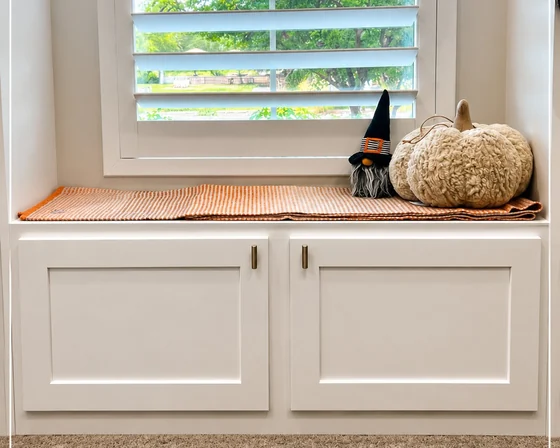
With the doors painted, installed, adjusted and fitted with hardware, the built-in now reads as a finished part of the room rather than an unfinished cabinet opening.
Fit and Finish Matter as Much as the Door Itself
The doors in the photo are shown before final painting and installation. At this stage, the important things are consistent spacing, square openings, clean hinge placement, and making sure the doors sit the way you expect before finish work begins.
Once the doors are fitted properly, the remaining work—primer, paint, hardware, and final adjustment—can make the cabinet feel like a fully integrated part of the room rather than an add-on.
Related DIY Projects
Bottom Line
Custom prefab cabinet doors can be a smart middle ground between fully stock doors and building every door yourself. You still get a custom fit, but you can skip a major part of the fabrication process. For this project, that made it easier to concentrate on the built-in itself and the details that will determine how finished the final installation looks.