
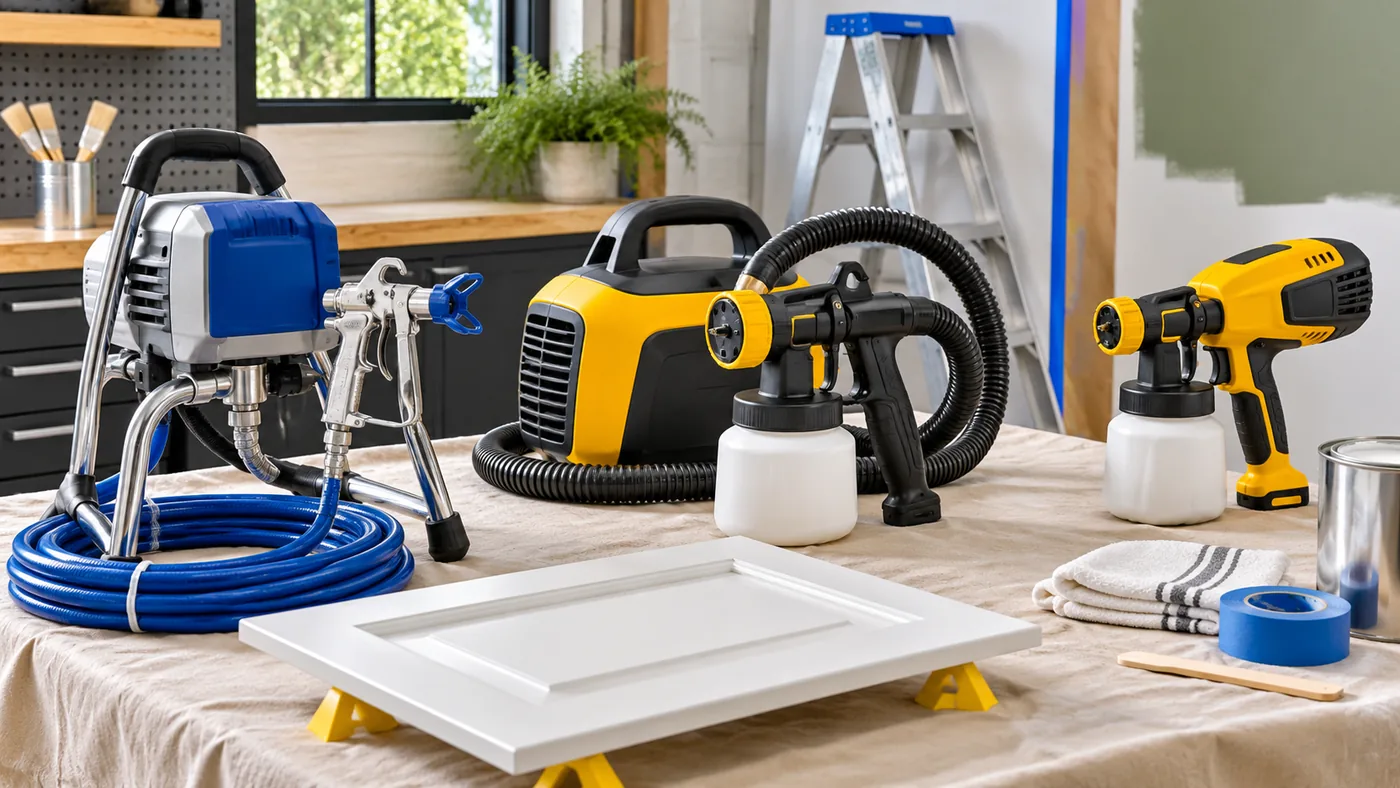
The best paint sprayer for home use depends more on the project than the brand name. An airless sprayer is hard to beat for walls, ceilings, siding and fences. An HVLP (High Volume, Low Pressure) sprayer gives you more control on cabinets, furniture and trim. A handheld sprayer is convenient when the job is too small to justify a full hose-and-pump setup.
Airless vs. HVLP vs. Handheld: The Short Version
| Sprayer type | Best for | Main advantage | Main tradeoff |
|---|---|---|---|
| Airless | Interior walls, ceilings, siding, fences, decks | Fast coverage and direct-from-can capability on many models | More overspray, masking and cleanup |
| HVLP | Cabinets, furniture, doors, trim, smaller rooms | Better control and a softer, more manageable spray pattern | Slower on big surfaces; cup capacity is limited |
| Handheld airless | Doors, trim, furniture, small walls, touch-up-size projects | Fast setup with no long hose | Small paint cup and more frequent refilling |
Airless Paint Sprayers
Best for large projectsAirless sprayers use high fluid pressure to atomize paint through a small tip. They move a lot of material quickly, which is why they are so effective on walls, ceilings and exterior surfaces.
Good fit if you paint
- Multiple rooms or an entire interior
- Fences, decks or siding
- Garages, sheds or outbuildings
- Large areas where speed matters more than minimal masking
Watch for
Overspray travels farther than many first-time users expect. Prep and masking can take longer than the actual spraying.
HVLP Paint Sprayers
Best for finish controlHVLP stands for High Volume, Low Pressure. Instead of relying on the very high fluid pressure used by an airless sprayer, an HVLP system moves a high volume of air at comparatively low pressure to break the coating into a fine spray. That softer, more controlled spray generally means less overspray and makes it easier to work around cabinet doors, furniture, trim and other projects where finish quality matters more than raw square-foot speed.
Good fit if you paint
- Cabinets and built-ins
- Furniture
- Interior doors and trim
- Smaller walls or accent projects
Watch for
Material setup matters. Some coatings spray unthinned through current homeowner HVLP systems, while others may still need adjustment or thinning according to the coating and sprayer instructions.
Handheld Sprayers
Best for convenienceA handheld sprayer puts the pump and paint container in your hand. There is no long hose to prime or clean, which makes this style appealing for jobs that are bigger than a brush project but smaller than a whole-house job.
Good fit if you paint
- Doors and shutters
- Trim and small walls
- Outdoor furniture
- Garage doors and small fences
Watch for
The cup is the limiting factor. A handheld can spray surprisingly fast, but frequent refills become annoying on large rooms or exterior jobs.
Current Homeowner Models Worth Comparing
These are useful reference points because they represent the main categories rather than four versions of the same machine.
| Model | Type | Why it stands out | Best fit |
|---|---|---|---|
| Graco Magnum X5 | Airless | Sprays directly from 1- or 5-gallon containers, adjustable pressure, compact stand design | Rooms, decks, fences, siding and recurring larger projects |
| Wagner Control Pro 130 | HEA airless | 1.5-gallon tank, 25-ft hose and a lower-overspray approach than traditional airless designs | Homeowners who want airless speed with a more controlled spray fan |
| Wagner FLEXiO 3500 | HVLP | Variable turbine settings with broad-surface and detail nozzles | Walls, cabinets, furniture, trim and mixed indoor/outdoor projects |
| Graco TrueCoat 360 Variable Speed | Handheld airless | Variable speed, reversible tips and a 32-oz FlexLiner cup | Doors, trim, furniture and projects around two gallons or less |
Model specifications can change. Confirm current coating compatibility, tip size and included accessories before buying.
For Walls and Ceilings
Airless is usually the most efficient choice once the room is fully masked. The speed advantage becomes meaningful when you are painting several walls, ceilings or an entire house.
The tradeoff is prep. Windows, floors, fixtures, cabinets, furniture and adjoining rooms need more protection than they would with a roller. If you are painting one small bedroom and the room is furnished, a roller may still be simpler overall.
For Cabinets, Furniture and Trim
HVLP is easier to control when you care about edge coverage, surface detail and minimizing the amount of paint floating around the workspace. A detail nozzle can also make it easier to work around cabinet frames and furniture profiles.
A handheld airless can also be a good cabinet-door tool, especially if the sprayer offers a narrow pattern and variable speed. Test on scrap before committing to the finished pieces.
Paint Sprayer Clogging: Why It Happens and How to Prevent It
There is enough manufacturer troubleshooting guidance to say this clearly: tip clogging is one of the most common paint-sprayer problems, especially with airless systems. A clog does not automatically mean the sprayer is defective. Paint debris, dried material, dirty filters, the wrong tip or coating that is too thick can all restrict flow.
Common causes of paint sprayer clogs
- Debris or dried paint in the coating. Skin from an opened can or small dried particles can be larger than the tip opening.
- Dirty gun, pump or inlet filters. Restricted screens and filters reduce flow and can create an erratic pattern that feels like a tip problem.
- A tip that is too small for the material. Thicker coatings need a compatible orifice size, within the sprayer's rated capacity.
- A worn spray tip. A worn tip can produce an inconsistent pattern and may need replacement rather than repeated cleaning.
- Paint drying during a pause. Material can dry around the tip or inside exposed passages if the sprayer sits too long without the pause procedure recommended for that model.
- Material that is too thick. Some coatings and sprayer combinations require thinning, but only when the paint and sprayer manufacturers allow it.
What helps prevent clogging
How reversible airless tips are cleared
Many homeowner airless sprayers use a reversible tip. The general process is to engage the trigger lock, rotate the tip to its unclog position, point the gun into a waste container, unlock and briefly trigger the sprayer, then lock the trigger again and rotate the tip back to the spray position. Always follow your sprayer's pressure-relief and safety instructions.
If it keeps clogging
Repeated clogs usually mean there is another restriction or a mismatch somewhere in the system. Check the gun filter, pump filter and inlet screen; strain the coating; verify the tip size; and confirm that the paint is within the sprayer's material requirements. Wagner also notes that an older or undersized tip can contribute to repeated clogging.
Do You Need to Thin Paint for a Home Paint Sprayer?
Not always. Current Graco homeowner airless models and Wagner FLEXiO models are designed to spray many common paints without thinning. But that does not mean every paint, primer and sprayer combination should be treated the same way.
If the pattern tails, flow is weak or the material is outside the recommended viscosity range, check the paint label and sprayer manual before adding water or solvent. Never thin a coating simply to force it through an incompatible sprayer or tip.
Overspray, Masking and Ventilation Matter More Than Beginners Expect
The purchase decision is only part of the job. Spraying can be dramatically faster than brushing or rolling, but the surrounding area needs to be protected. Cover floors, windows, doors, fixtures and anything else that should not receive overspray.
Use the personal protective equipment and ventilation required by the coating and sprayer instructions. Paint mist is not something you want to breathe, and flammable coatings have additional restrictions.
Should You Buy or Rent a Paint Sprayer?
If you have one exterior project and do not expect to spray again, renting can make sense. Buying becomes easier to justify when you have a sequence of projects—rooms now, a fence later, cabinets next year—or when you want the freedom to work in shorter sessions without a rental clock running.
Also factor cleanup into the decision. Owning a sprayer means you can learn one machine's setup, tips, filters and cleaning routine instead of starting over with unfamiliar rental equipment each time.
How We Would Choose a Home Paint Sprayer
| If your priority is… | Start with | Why |
|---|---|---|
| Painting rooms, ceilings, siding or long fences | Airless | Fastest coverage on large surfaces |
| Cabinets, furniture and trim | HVLP | More control for finish-oriented work |
| Doors, shutters and occasional smaller jobs | Handheld | Less setup and no long hose |
| A mix of walls and detail projects | HVLP or variable-speed handheld | More flexible than a high-output airless for small jobs |
| Recurring whole-house DIY projects | Stand airless | Better capacity and less refilling |
Home Paint Sprayer FAQ
What is the best paint sprayer for a beginner?
For a small first project, an HVLP or variable-speed handheld sprayer is often easier to control. If your first project is several rooms or a large fence, an airless sprayer may still be the better tool as long as you are prepared for masking and cleanup.
Is airless or HVLP better for interior walls?
Airless is faster for large wall areas. HVLP can work on walls, but it is generally slower and may require more refilling. HVLP becomes more attractive when the same project also includes cabinets, trim or furniture.
Why does my paint sprayer keep clogging?
Common causes include debris in the paint, dirty filters or inlet screens, dried coating around the tip, an incompatible tip size, a worn tip or material that is too thick for the setup.
Should I strain new paint before spraying?
It is a good precaution, especially with airless systems. Manufacturer troubleshooting guidance specifically recommends straining paint when tip clogs are recurring.
Can a paint sprayer replace a roller for every project?
No. Sprayers are excellent when speed or finish quality justifies the setup, but masking and cleanup can outweigh the benefit on a small occupied room or a one-wall touch-up.
Bottom Line
For most homeowners, there is no single best paint sprayer for every job. Airless wins on speed, HVLP wins on control, and handheld sprayers win on convenience. Match the machine to the surfaces you actually expect to paint rather than buying the highest-output sprayer you can afford.
What matters most
Tip compatibility, cleanup, overspray control and clog prevention matter as much as motor size. A sprayer that fits your project and that you are willing to clean properly is more useful than a larger machine that stays on the shelf.
Research Sources & Methodology
This guide compares homeowner sprayer types using current manufacturer product specifications, operating guidance and troubleshooting documentation reviewed November 11, 2026. Product examples are representative models, not paid placements.